Chanakya Niti Full Hindi Audiobook - All 17 Chapters - Life Lessons & Wisdom

In this guide
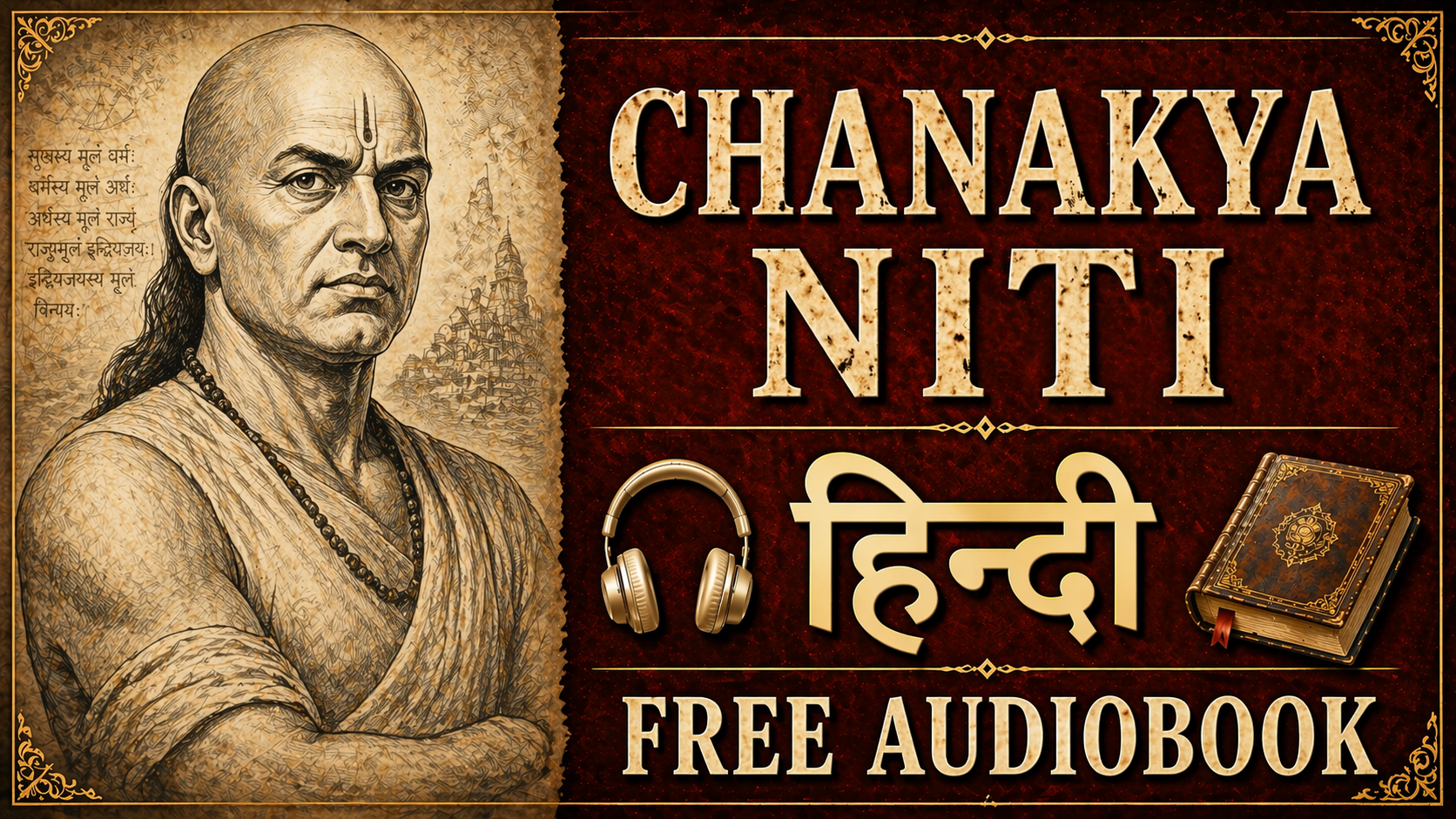
Listen to Chanakya Niti (चाणक्य नीति) in this free Hindi audiobook featuring all 17 chapters of a famous collection of traditional Indian teachings on wisdom, human nature, relationships, money, discipline, and practical decision-making.
How can you recognize people you should trust? Why is knowledge more valuable than appearances? What can ancient wisdom teach us about money, friendship, self-control, and making better decisions?
Chanakya Niti offers thought-provoking advice on these questions and many others.
Traditionally associated with the ancient Indian thinker Chanakya, also known as Kautilya or Vishnugupta, this collection of verses explores the practical difficulties of human life.
The teachings discuss friendship and betrayal, education and good conduct, wealth and poverty, patience and anger, family relationships, and the importance of using intelligence before acting.
Our Hindi audiobook presents all 17 chapters in one recording lasting approximately 1 hour and 41 minutes.
You can listen to the full audiobook on YouTube or Spotify. We also have a separate 24-minute Hindi summary explaining selected lessons in simple language.
Listen to Chanakya Niti on YouTube
Experience the complete 17-chapter Hindi audiobook of Chanakya Niti for free on our YouTube channel.
The narration follows the teachings in chapter order, exploring traditional ideas about human behavior, education, morality, relationships, wealth, and self-discipline.
It is suitable for listeners interested in Indian philosophy, practical wisdom, personal growth, and the history of ethical thought.
Complete Chanakya Niti Hindi Audiobook – All 17 Chapters
Listening time: 1 hour, 41 minutes, 21 seconds
This single recording covers the full 17-chapter sequence of Chanakya Niti presented in our Hindi edition.
It begins with advice about caution, judgment, and understanding people.
As the chapters continue, the teachings explore the value of education, the importance of examining a person's character, the dangers of greed, the role of good company, the use of wealth, and the need for discipline.
The later chapters also contain reflections on time, good deeds, compassion, self-control, and the value of learning.
Because Chanakya Niti is a collection of short teachings rather than a continuous story, you can listen from beginning to end or return to individual chapters whenever you wish.
Listen to the full audiobook (embedded):
Listen to the full audiobook:
Chanakya Niti – Complete 17-Chapter Hindi Audiobook on YouTube
Chanakya Niti YouTube Playlist
Prefer listening through a playlist, chapter by chapter?
Our Chanakya Niti YouTube playlist offers another way to access the audiobook content and follow the teachings at your own pace.
Listen to Chanakya Niti – Hindi Audiobook YouTube Playlist
All 17 Chapters – Listening Timestamps
The full recording includes an introduction followed by 17 chapters.
Here are the exact starting points:
- 00:00:00 – Introduction
- 00:00:40 – Chapter 1
- 00:05:23 – Chapter 2
- 00:10:54 – Chapter 3
- 00:16:53 – Chapter 4
- 00:22:20 – Chapter 5
- 00:28:34 – Chapter 6
- 00:34:39 – Chapter 7
- 00:40:23 – Chapter 8
- 00:46:39 – Chapter 9
- 00:51:04 – Chapter 10
- 00:57:15 – Chapter 11
- 01:02:38 – Chapter 12
- 01:09:59 – Chapter 13
- 01:15:35 – Chapter 14
- 01:21:05 – Chapter 15
- 01:27:42 – Chapter 16
- 01:33:46 – Chapter 17
The chapters contain short observations on different aspects of life rather than one central topic each. You may find several connected ideas appearing throughout the book.
Watch the Chanakya Niti Summary in Hindi
Don't have time to listen to all 17 chapters?
We also created a shorter Hindi video exploring some of Chanakya Niti's most important ideas about people, money, power, discipline, and everyday life.
Chanakya Niti Summary – The Hard Truth About People, Money and Power
Video length: 24 minutes and 30 seconds
The summary explains selected ideas from Chanakya Niti in simple Hindi and connects them to situations people face today.
It explores questions such as:
- How can you decide whom to trust?
- Why should you think carefully before revealing personal plans?
- When is remaining silent wiser than arguing?
- Why is controlling anger important?
- How should money be earned, protected, and used?
- Why do knowledge and discipline matter more than showing off?
- How can small problems grow into serious difficulties?
- Why is learning from failure better than repeating the same mistakes?
The summary also discusses emotional control, protecting your time, understanding human behavior, and developing better judgment.
It is especially useful if you want a quick introduction before listening to the full audiobook.
Watch the Hindi summary:
Chanakya Niti Summary in Hindi – People, Money, Power & Self-Control
This summary is a modern explanation of selected teachings, not a replacement for the complete 17-chapter audiobook.
Listen to Chanakya Niti on Spotify
Prefer listening on Spotify?
You can also enjoy Chanakya Niti in Hindi on Spotify.
The full recording covers the same 17-chapter audiobook presented on our YouTube channel.
Spotify provides another convenient way to listen while traveling, walking, relaxing, or studying the teachings.
Chanakya Niti – Full Hindi Audiobook on Spotify
Listen to the complete Hindi audiobook and explore the teachings on wisdom, money, relationships, character, education, and practical living.
Listen to Chanakya Niti – Complete Hindi Audiobook on Spotify
About Chanakya Niti
Chanakya Niti, also written as Chanakya Neeti or चाणक्य नीति, is a traditional Indian collection of short teachings about wise and ethical conduct, practical judgment, and human relationships.
The word niti refers broadly to principles of conduct, practical wisdom, and guidance for making decisions.
The collection is traditionally attributed to Chanakya, an important figure in ancient Indian political thought who is also known as Kautilya or Vishnugupta.
Chanakya is associated with Chandragupta Maurya and the establishment of Mauryan rule in ancient India.
However, the precise authorship and dating of the Chanakya Niti collections are uncertain. Different versions of the sayings have circulated over time.
The widely known Chanakya Niti Darpana tradition is organized into 17 chapters.
Unlike a novel, Chanakya Niti does not follow one main character or tell a continuous story.
Instead, it presents short observations, comparisons, warnings, and pieces of advice about different aspects of life.
Its subjects include:
- Human nature and behavior
- Friendship and trust
- Family and relationships
- Money and financial security
- Education and knowledge
- Good and bad company
- Discipline and self-control
- Time and opportunity
- Patience and judgment
- Character and reputation
- Duty and good conduct
- Greed and anger
- Compassion and charity
- Spiritual and moral reflection
Some teachings offer advice that still feels practical today.
Others reflect the social hierarchy, family expectations, and religious beliefs of the historical traditions in which they were transmitted.
For that reason, Chanakya Niti is best approached both as a source of practical ideas and as a historical text that deserves thoughtful interpretation.
Who Was Chanakya?
Chanakya is traditionally described as a scholar, political thinker, teacher, and strategist associated with the rise of the Maurya Empire in ancient India.
He is often identified with the names Kautilya and Vishnugupta.
According to historical and literary traditions, he played an important role in the political career of Chandragupta Maurya, who became the founder of the Maurya Empire.
Chanakya is particularly famous for his association with the Arthashastra, an influential work on government, economics, law, administration, diplomacy, and political strategy.
He is also traditionally associated with the sayings collected under the name Chanakya Niti.
Although these two texts share an association with Chanakya, they are not the same work.
Chanakya Niti focuses more on short teachings about conduct, judgment, relationships, learning, and the practical realities of life.
The Arthashastra is a much broader and more systematic treatise about ruling a state and managing political power.
If you are interested in both subjects, you can listen to our Arthashastra Hindi Audiobook by Kautilya.
Core Message of Chanakya Niti
Wisdom is not simply knowing what is right. It also involves understanding people, controlling your actions, recognizing risks, and making thoughtful decisions.
Chanakya Niti repeatedly emphasizes the importance of good judgment.
A person may possess money, status, or influence, but these advantages do not necessarily guarantee wisdom.
Someone may have many friends yet fail to recognize who is trustworthy.
Another person may possess knowledge but lack the discipline to use it effectively.
The teachings encourage the listener to pay attention to character, conduct, education, and the possible consequences of decisions.
They also examine the importance of restraint.
Not every thought needs to be spoken.
Not every conflict needs to be pursued.
And not every attractive opportunity is necessarily a wise choice.
Another recurring message concerns the value of learning.
Money and possessions can be lost, while acquired knowledge and well-developed judgment can continue helping a person throughout life.
The collection also encourages reflection on the qualities that support a meaningful life: honesty, good company, generosity, compassion, thoughtful conduct, and self-control.
Not every ancient teaching should be treated as a universal rule for modern life. But many of the questions Chanakya Niti raises remain worth examining.
Structure and Listening Guide – All 17 Chapters
Chanakya Niti is arranged as a sequence of short teachings.
The audiobook follows all 17 chapters in order.
Because individual chapters discuss several subjects, the guide below highlights broad ideas present throughout the recording rather than assigning an invented single theme to each chapter.
Caution, Wisdom and Understanding People
The opening chapters introduce the importance of careful judgment.
The teachings encourage listeners to consider the character of the people around them and to recognize situations that might lead to trouble.
They also discuss why a person's behavior can reveal more than promises or outward appearances.
One practical takeaway is to avoid judging trustworthiness only from friendly words.
A person's actions, reliability, and conduct in difficult circumstances may provide a better basis for judgment.
Friendship, Family and Good Company
Several teachings examine the influence of relationships.
Family members, friends, teachers, and companions can shape our habits and decisions.
Good company can encourage learning, discipline, and positive behavior.
Harmful company can create unnecessary difficulties.
The text also reflects traditional ideas about household life and the duties of family members.
Some of these ideas are rooted in historical social norms and should be considered critically rather than adopted without question.
Education and the Value of Knowledge
One of the strongest recurring themes is the value of education.
The teachings place great importance on learning, listening carefully, developing understanding, and respecting teachers.
In Chapter 10, the narration explicitly emphasizes the idea that knowledge is a person's true wealth.
The practical meaning is that possessions and social position alone do not determine a person's worth or abilities.
Knowledge can help people recognize opportunities, avoid mistakes, and act more wisely.
Money, Security and Financial Judgment
Chanakya Niti frequently discusses money and wealth.
The teachings emphasize prudence, preparation for difficult times, and the importance of using resources thoughtfully.
They distinguish between having wealth and possessing the judgment needed to manage it.
Financial security can protect people from certain difficulties, but money does not guarantee wisdom, happiness, or good character.
The modern lesson is to treat money as a useful resource rather than simply a symbol of status.
Speech, Secrecy and Self-Control
Another important subject is knowing when to speak and when to remain silent.
The teachings discuss the dangers of careless speech, revealing private matters, and acting without considering the consequences.
Being cautious does not mean distrusting everyone.
It means recognizing that some information should be shared thoughtfully and that not every disagreement requires an immediate response.
Self-control is especially valuable when emotions are strong.
Time, Action and Personal Responsibility
The collection also examines the importance of good conduct and using time wisely.
Several teachings emphasize that actions have consequences.
A person cannot necessarily control everything that happens, but their choices, habits, and behavior still matter.
The narration includes advice about avoiding unnecessary regret over the past and excessive worry about the future.
Instead, the listener is encouraged to act with awareness in the present.
Contentment, Compassion and Good Character
The later chapters include reflections on contentment, charity, compassion, learning, and the nature of a good life.
Chapter 12 discusses ideas associated with a harmonious household and good company.
The final chapters also emphasize the value of knowledge, generosity, and positive personal qualities.
The conclusion of Chapter 17 includes the image of a fragrant flower whose attractive quality outweighs its imperfections.
This becomes a memorable reminder that a genuine positive quality can have a powerful influence on how a person is remembered.
Key Life Lessons from Chanakya Niti
1. Look at Actions, Not Just Words
People can make promises easily.
A more reliable way to understand someone's character is to observe what they do over time.
Consistency, honesty, and behavior during difficult circumstances can reveal qualities that words alone cannot.
2. Knowledge Is More Valuable Than Showing Off
Wealth and status may impress others, but knowledge can improve decisions throughout life.
A person who continues learning may become better prepared for changing circumstances.
3. Control Your Anger
Anger can make people speak or act before they understand the consequences.
Developing emotional self-control helps create room for better judgment.
The modern Hindi summary especially emphasizes choosing thoughtful responses instead of reacting to every provocation.
4. Be Careful About Whom You Trust
Trust is important for healthy relationships, but it should be accompanied by observation and judgment.
Blind trust can expose someone to avoidable difficulties.
At the same time, excessive suspicion can damage meaningful relationships.
The practical lesson is to build trust through experience.
5. Use Money Wisely
Money can provide security and opportunities.
But careless spending, greed, or a desire to impress others can create unnecessary problems.
Financial decisions should consider future needs as well as present desires.
6. Protect Your Time
Time is a limited resource.
The teachings repeatedly emphasize the importance of effort, learning, and using opportunities wisely.
A useful modern interpretation is to avoid spending energy on activities that do not contribute to meaningful goals or responsibilities.
7. Choose Your Company Carefully
The people around us can influence our behavior.
Friends and companions who encourage honesty, learning, and responsible conduct may have a positive effect.
Relationships built on manipulation or harmful habits can have the opposite effect.
8. Do Not Let Pride Replace Wisdom
Confidence can help people act.
But excessive pride may prevent them from recognizing mistakes or accepting useful advice.
Humility makes it easier to learn and improve.
9. Think Before Making Important Decisions
Not every opportunity is as good as it first appears.
Thoughtful decisions require examining risks, available information, likely consequences, and personal responsibilities.
10. Learn from Difficult Experiences
Mistakes and setbacks are unavoidable.
What matters is whether we use those experiences to improve our understanding and behavior.
The teachings invite listeners to think about the relationship between their choices and the circumstances they face.
11. Practice Contentment Without Abandoning Growth
Contentment can help a person appreciate what they already have.
But it does not necessarily mean avoiding learning or giving up on improvement.
A balanced life can include gratitude alongside curiosity and ambition.
12. Develop Good Character
A positive reputation built on honest conduct can be more valuable than one based only on appearance or wealth.
The collection repeatedly returns to the importance of learning, generosity, restraint, and personal qualities.
Chanakya Niti and Arthashastra – What Is the Difference?
Many people search for Chanakya Niti and Arthashastra as though they are two names for the same book.
They are different works.
Chanakya Niti is a collection of short teachings traditionally associated with Chanakya.
Its main subjects include personal conduct, education, family relationships, practical wisdom, wealth, and human behavior.
Arthashastra is a much larger treatise traditionally associated with Kautilya.
It focuses on the organization of the state, administration, taxation, economic policy, diplomacy, intelligence, law, and military strategy.
Chanakya Niti may appeal to someone interested in practical life advice and personal judgment.
Arthashastra may appeal to someone interested in political strategy, governance, leadership, and the workings of power.
The two works also have different textual histories, and scholars have examined questions about their authorship and transmission.
If you would like to explore the political and strategic side of these traditions, listen to our Arthashastra Hindi Audiobook.
Core Themes of Chanakya Niti
The teachings explore:
- Wisdom and practical judgment
- Human nature and behavior
- Friendship and trust
- Money and financial security
- Knowledge and education
- Discipline and self-control
- Relationships and family life
- Character and reputation
- Speech and silence
- Anger and greed
- Patience and contentment
- Good and harmful company
- Time and opportunity
- Personal responsibility
- Charity and compassion
- Ethics and traditional social duties
- The consequences of human actions
These themes make Chanakya Niti an interesting source of reflection for people studying classical Indian thought and practical philosophy.
Should Every Teaching in Chanakya Niti Be Followed Today?
Not necessarily.
Chanakya Niti comes from a historical literary tradition with values and social assumptions that differ from many modern perspectives.
Some verses express restrictive views about women, social hierarchy, or family roles. Other passages use severe comparisons and warnings to make their points.
It is important to understand these ideas in their historical context.
Studying a classic text does not require agreeing with every statement in it.
A thoughtful listener can appreciate valuable insights about learning, self-discipline, and judgment while questioning teachings that conflict with equal dignity, fairness, or modern ethical standards.
The greatest benefit of reading or listening to an ancient philosophical work may come from examining its ideas carefully rather than accepting them automatically.
Frequently Asked Questions About Chanakya Niti
Is the Chanakya Niti Hindi audiobook free?
Yes. Our full 17-chapter Hindi audiobook is available for free on YouTube.
You can also access the Spotify recording through the link provided above.
How many chapters are in Chanakya Niti?
The widely circulated Chanakya Niti Darpana collection contains 17 chapters.
Our audiobook follows this 17-chapter arrangement.
How long is the Chanakya Niti Hindi audiobook?
Our full YouTube audiobook runs for 1 hour, 41 minutes, and 21 seconds.
Is Chanakya Niti available on Spotify?
Yes. The Spotify episode is linked in the listening section above.
Is there a short Chanakya Niti summary in Hindi?
Yes. Our YouTube summary runs for approximately 24 minutes and 30 seconds.
It explains selected teachings about people, money, power, self-control, and better decisions.
Who wrote Chanakya Niti?
The collection is traditionally attributed to Chanakya, also known as Kautilya.
However, scholars have identified different versions of sayings attributed to Chanakya, and the exact authorship and dates of their composition are not firmly established.
Who was Chanakya?
Chanakya was an ancient Indian political thinker and strategist traditionally associated with Chandragupta Maurya and the early Maurya Empire.
He is also commonly identified with the names Kautilya and Vishnugupta.
Is Chanakya Niti the same as Arthashastra?
No.
Chanakya Niti is a collection of short teachings about conduct and practical wisdom.
Arthashastra is a much broader treatise about politics, economics, government, and statecraft.
What does Chanakya Niti teach?
It explores practical judgment, human relationships, education, wealth, self-control, good conduct, and the consequences of different choices.
Is Chanakya Niti only about politics?
No.
Although it is associated with an important political thinker, Chanakya Niti discusses many subjects relating to everyday life, family, money, learning, and human nature.
Is Chanakya Niti useful for students?
Students interested in Indian philosophy and traditional ethical literature may find it valuable.
Its teachings about learning, discipline, attention, and the importance of education are particularly relevant subjects for reflection.
Can Chanakya Niti help with financial decisions?
The collection contains advice about wealth, preparation, and prudent conduct.
However, these traditional teachings should be viewed as general philosophical ideas rather than modern financial advice.
Is Chanakya Niti suitable for beginners?
Yes.
Its short teachings make it relatively approachable, especially in Hindi audio form.
Some passages may require historical context or critical interpretation.
Is Chanakya Niti in the public domain?
The ancient Sanskrit verses are generally in the public domain.
However, modern translations, adaptations, explanations, and audio recordings may have separate copyright protection.
What is the main message of Chanakya Niti?
One recurring message is that a good life requires thoughtful judgment, knowledge, self-control, awareness of human behavior, and responsible action.
Where can I listen to Chanakya Niti in Hindi?
You can listen to the full 17-chapter audiobook on YouTube or Spotify, and watch our shorter Hindi summary using the links at the beginning of this article.
Why Chanakya Niti Still Matters Today
The world has changed enormously since the historical traditions associated with Chanakya first developed.
We now live in a world of smartphones, social media, modern businesses, global communication, and rapidly changing technology.
Yet many human challenges remain familiar.
People still struggle to decide whom to trust.
They still face disagreements, financial problems, ambition, fear, temptation, and uncertainty.
They still make mistakes when emotions become stronger than judgment.
And they still need to decide how to use their time, knowledge, and resources wisely.
This is one reason Chanakya Niti continues to attract attention.
Its teachings encourage people to examine behavior rather than simply accepting appearances.
They also invite reflection on the relationship between education and good judgment.
Knowledge is useful not only because it helps someone earn money or achieve status, but because it can improve their understanding of the world.
The advice about self-control is particularly interesting in modern life.
Social media makes it easy to react immediately to criticism or disagreement.
But not every argument deserves our attention.
Sometimes the better decision is to think before responding, recognize when emotions are influencing us, or choose not to participate in an unnecessary conflict.
The teachings about wealth also remain thought-provoking.
Modern life often encourages people to compare themselves with others through possessions, income, and lifestyle.
Yet having money and knowing how to manage it are not the same thing.
Financial security may depend on preparation, restraint, and judgment rather than appearances alone.
Relationships are another important subject.
Chanakya Niti asks readers to pay attention to character, loyalty, and the influence of their companions.
Although some of its traditional social judgments should be questioned today, the broader question of how people influence one another remains relevant.
Ultimately, the value of Chanakya Niti is not that every ancient statement provides a perfect answer to modern problems.
Its value lies in offering ideas that listeners can examine, question, and compare with their own experience.
Wisdom grows when we learn to think carefully, question our assumptions, and act with greater awareness.
Explore More Free Hindi Audiobooks
At Free Hindi Audiobooks, we are building a growing library of classic literature, philosophy, spirituality, history, and personal development works available in Hindi.
Our goal is to make great books and valuable ideas accessible to Hindi-speaking listeners without financial barriers.
If you enjoyed Chanakya Niti, we recommend exploring another influential work associated with the same ancient Indian intellectual tradition.
Listen Next: Arthashastra by Kautilya (Chanakya)
If Chanakya Niti introduced you to traditional ideas about wisdom, judgment, and human behavior, Arthashastra by Kautilya is a natural next listen.
While Chanakya Niti focuses on short teachings about conduct and practical life, Arthashastra explores the larger questions of political strategy, leadership, economic management, and governance.
The Arthashastra discusses how rulers organize their states, select advisers, manage resources, respond to threats, and balance competing interests.
It examines the practical challenges of power and responsibility in a complex society.
The two works are different, but studying both offers a broader introduction to the political and ethical ideas associated with Chanakya.
Listen to the Arthashastra Hindi audiobook:
Arthashastra by Kautilya – Hindi Audiobook on YouTube
You can also read our full Arthashastra Hindi Audiobook Guide.
For another perspective on political power and strategic decision-making, explore The Prince by Niccolò Machiavelli – Hindi Audiobook.
Continue discovering timeless wisdom, philosophy, and important ideas through our free Hindi audiobook collection.
Listen, reflect, question, and discover which lessons can help you think more clearly about your own life.