Frankenstein Full Hindi Audiobook by Mary Shelley - Science, Horror & Humanity

In this guide
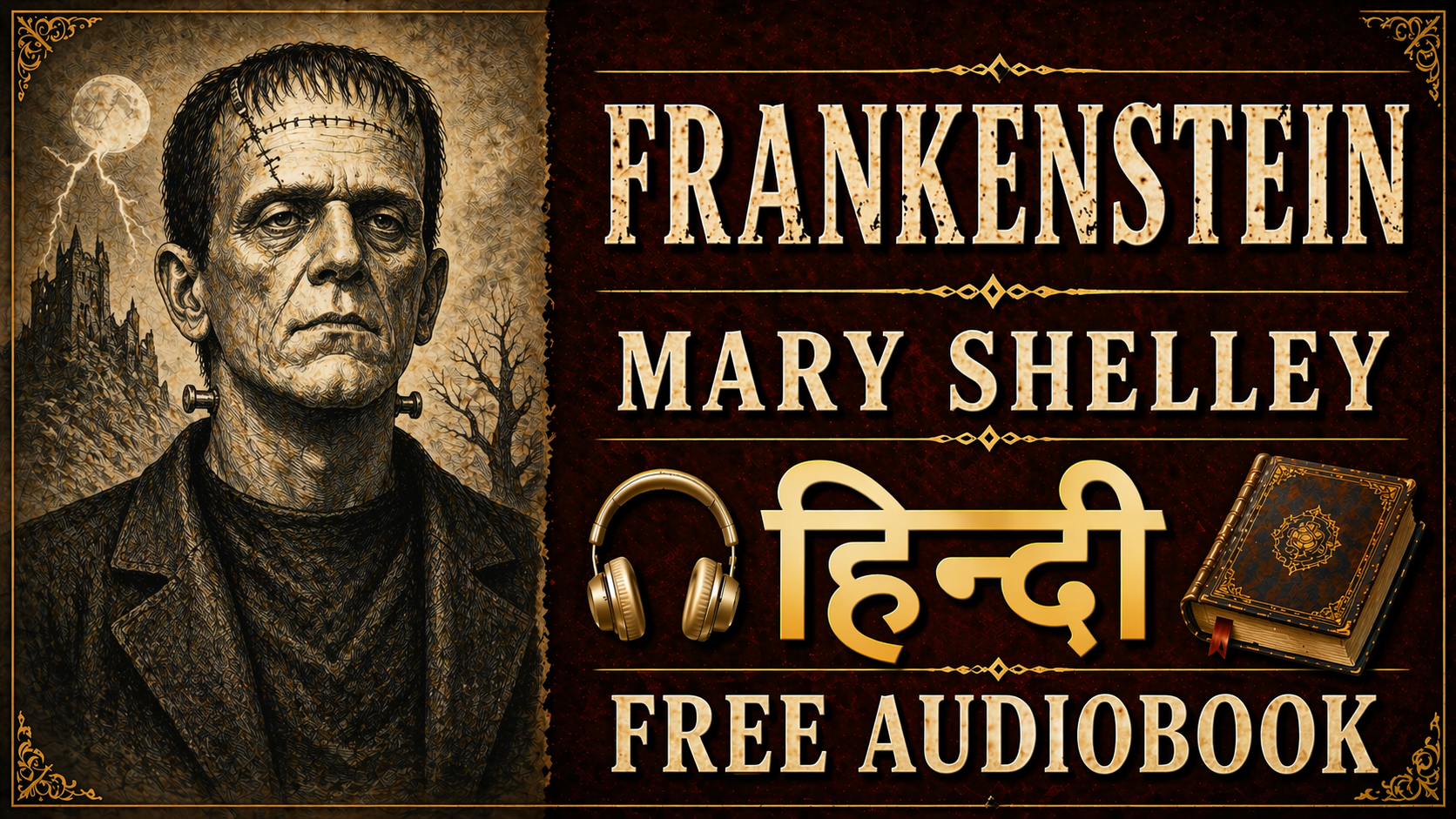
Listen to Frankenstein by Mary Shelley in this complete, free Hindi audiobook of one of the most influential Gothic horror and science fiction novels ever written.
What happens when a scientist discovers how to create life but refuses to take responsibility for what he has created?
Is someone born a monster, or can loneliness, rejection, and cruelty turn them into one?
Frankenstein tells the tragic story of Victor Frankenstein, an ambitious young scientist who becomes obsessed with understanding the mysteries of life and death.
After years of study and experimentation, Victor succeeds in bringing a new living creature into existence.
But instead of celebrating his achievement, he is horrified by the creature's appearance and abandons it.
The creature enters a world where people fear and reject him. As he struggles to understand humanity, his loneliness gradually turns into anger, suffering, and a desire for revenge.
What follows is an unforgettable story about science, ambition, loneliness, responsibility, compassion, and the consequences of our choices.
Our complete Hindi audiobook includes four introductory letters and all 24 chapters, with a total listening time of approximately 10 hours and 56 minutes.
You can listen for free on YouTube or Spotify.
Listen to Frankenstein on YouTube
Experience the complete Frankenstein Hindi audiobook on our YouTube channel.
The recording begins with Captain Robert Walton's letters from his Arctic expedition, then follows Victor Frankenstein's life, his scientific experiments, and the tragic consequences of his creation.
Frankenstein – Complete Hindi Audiobook
Listening time: 10 hours, 56 minutes, 4 seconds
This full-length recording presents Mary Shelley's classic novel in Hindi, from the opening letters to the final events aboard Walton's ship.
You will discover:
- Victor Frankenstein's childhood and education
- His growing obsession with scientific discovery
- The creation of a living being
- The creature's loneliness and struggle to understand humanity
- The tragic consequences of rejection
- The creature's demand for a companion
- Victor's impossible moral decisions
- The final pursuit across the frozen Arctic
Frankenstein is not simply a frightening story about a scientist and his creation.
It is also a deeply emotional and philosophical novel about what it means to be human.
Listen to the complete audiobook:
Frankenstein by Mary Shelley – Full Hindi Audiobook on YouTube
Frankenstein Hindi Audiobook YouTube Playlist
Prefer listening through a playlist?
You can also explore our Frankenstein Hindi audiobook playlist, making it easier to return to the story and continue listening at your own pace.
Listen to Frankenstein – Hindi Audiobook YouTube Playlist
Listen to Frankenstein on Spotify
Prefer listening on Spotify?
You can also enjoy Frankenstein by Mary Shelley in Hindi on Spotify.
Follow the story of Victor Frankenstein and his creation through this classic tale of science, ambition, isolation, and moral responsibility.
Frankenstein – Full Hindi Audiobook on Spotify
The complete recording follows the novel from the letters of Robert Walton through Victor's scientific experiments, the creature's experiences, and the final confrontation in the Arctic.
Listen to Frankenstein – Complete Hindi Audiobook on Spotify
Frankenstein Spotify Playlist
You can also use our dedicated Spotify playlist to access the audiobook.
Frankenstein by Mary Shelley – Hindi Audiobook Spotify Playlist
About Frankenstein by Mary Shelley
Frankenstein; or, The Modern Prometheus is a Gothic novel written by English author Mary Shelley and first published anonymously in 1818.
A revised edition appeared in 1831.
The novel is widely recognized as a foundational work of science fiction and one of the most important Gothic stories in English literature.
Mary Shelley began developing the story in 1816, during a visit to the Lake Geneva region of Switzerland.
That summer, she spent time with writers including Percy Bysshe Shelley and Lord Byron. A challenge to create ghost stories helped inspire the work that eventually became Frankenstein.
The novel follows Victor Frankenstein, a young scientist fascinated by the origins of life.
While studying at the University of Ingolstadt, he becomes determined to discover the secret of creating a living being.
His experiment succeeds, but the result terrifies him.
Instead of caring for the creature, Victor abandons it.
The creature must then learn how to survive in a world that treats him as frightening and dangerous.
As the story develops, Mary Shelley explores questions that go far beyond traditional horror.
What responsibilities do creators have toward their creations?
Can intelligence exist without kindness?
Does physical appearance determine moral character?
What happens when ambition becomes more important than human relationships?
And who is truly responsible when suffering leads to violence?
These questions make Frankenstein a powerful work of literature, philosophy, and psychological horror.
Who Is Frankenstein – The Scientist or the Monster?
One of the most common misunderstandings about this novel concerns the name Frankenstein.
Victor Frankenstein is the scientist, not the creature.
The being he creates is not given a personal name in the original novel.
He is usually referred to as the creature, the being, or by other descriptive terms.
Popular culture often calls him Frankenstein's monster.
However, Mary Shelley's story gives this unnamed creature intelligence, emotions, memories, desires, and the ability to reflect on his own existence.
He is not simply a mindless monster.
He wants companionship, affection, acceptance, and a place in the world.
His tragedy begins when the person responsible for creating him refuses to care for him.
This distinction is essential to understanding the novel's deeper message.
Core Message of Frankenstein
Creating something powerful does not free us from responsibility for what happens afterward.
Victor Frankenstein is intelligent, curious, and ambitious.
He wants to accomplish something no one has achieved before.
But his desire for scientific success becomes separated from his responsibility toward other living beings.
When his experiment succeeds, he is unprepared for the emotional and moral consequences.
He immediately rejects the creature.
The creature, meanwhile, begins life without guidance, companionship, or an understanding of the world.
He gradually learns about people through observation.
He discovers language, history, kindness, affection, and family life.
But when he attempts to connect with human beings, his appearance repeatedly causes fear and rejection.
The novel explores how isolation and mistreatment can change a person's behavior.
At the same time, it does not excuse the terrible harm the creature eventually causes.
Both Victor and his creation make decisions that lead to suffering.
Frankenstein therefore presents a complicated conflict between ambition and responsibility, rejection and resentment, compassion and revenge.
Its deepest questions remain relevant whenever people gain the power to create, invent, or influence something with consequences they cannot fully control.
Structure and Listening Guide – Letters and All 24 Chapters
Our Hindi audiobook begins with four letters written by Captain Robert Walton, followed by 24 numbered chapters.
The chapter arrangement matches the widely circulated revised 1831 edition.
The following timestamps come from the published YouTube recording.
Opening Letters – Captain Robert Walton's Arctic Expedition
- 00:00:00 – Letter 1
- 00:10:29 – Letter 2
- 00:21:57 – Letter 3
- 00:24:52 – Letter 4
The novel opens with Captain Robert Walton, an explorer traveling toward the Arctic.
He writes letters to his sister, Margaret Saville, describing his ambitions, loneliness, and desire to achieve something extraordinary.
During the expedition, Walton's ship becomes surrounded by ice.
The crew encounters a mysterious traveler who is exhausted, ill, and pursuing someone across the frozen landscape.
This man is Victor Frankenstein.
Walton takes him aboard, and Victor begins telling the story of his life.
The opening letters establish an important connection between Walton and Victor: both are ambitious men who want to achieve something exceptional.
Chapters 1–5 – Victor's Childhood, Education and Creation
- 00:48:56 – Chapter 1
- 01:05:57 – Chapter 2
- 01:27:08 – Chapter 3
- 01:51:17 – Chapter 4
- 02:14:29 – Chapter 5
Victor describes his childhood in Geneva, his family, and his relationship with Elizabeth Lavenza and his close friend Henry Clerval.
He develops a powerful interest in science and the natural world.
After traveling to the University of Ingolstadt, his curiosity becomes an obsession with the secrets of life and death.
Victor spends enormous amounts of time studying and experimenting.
He neglects his health, relationships, and ordinary responsibilities.
Finally, he succeeds in bringing a newly assembled body to life.
But the moment of success becomes the moment of horror.
Victor is terrified by the creature's appearance and abandons it.
This event forms the foundation of the entire tragedy.
Chapters 6–10 – Tragedy, Guilt and Confrontation
- 02:33:49 – Chapter 6
- 02:57:40 – Chapter 7
- 03:29:23 – Chapter 8
- 03:58:05 – Chapter 9
- 04:17:50 – Chapter 10
Following the creation of the being, Victor becomes physically and emotionally unwell.
Henry Clerval helps care for him.
But Victor's temporary recovery is interrupted by devastating news from home.
His younger brother William has been murdered.
Justine Moritz, a young woman associated with the Frankenstein household, is accused of the crime.
Victor suspects that his creation may be responsible, but he cannot bring himself to explain the truth.
The tragedy deepens as an innocent person suffers because of circumstances Victor helped create.
Overwhelmed by guilt and grief, Victor travels into the mountains.
There, he encounters the creature again.
Instead of simply attacking Victor, the creature insists that his creator listen to his story.
Chapters 11–16 – The Creature Learns About Humanity
- 04:38:30 – Chapter 11
- 05:01:08 – Chapter 12
- 05:17:58 – Chapter 13
- 05:35:57 – Chapter 14
- 05:50:58 – Chapter 15
- 06:16:09 – Chapter 16
These chapters present the creature's account of his experiences after being abandoned.
He describes awakening into a world he does not understand.
At first, he struggles with hunger, cold, light, darkness, and other unfamiliar sensations.
He gradually learns to survive and discovers a small family living in a cottage.
By secretly observing the De Lacey family, he begins learning language and understanding human relationships.
He watches the family's affection, sacrifices, and difficulties.
He also reads books and reflects on human history, morality, and his own existence.
The creature begins to understand what it means to love and be loved.
But he also becomes painfully aware that he has no family, no community, and no accepted place in society.
When he attempts to make contact, rejection and fear destroy his hopes.
His loneliness turns into anger.
The creature's story becomes one of the novel's most important examinations of empathy, prejudice, and the emotional consequences of isolation.
Chapters 17–20 – The Demand for a Companion
- 06:41:59 – Chapter 17
- 06:58:06 – Chapter 18
- 07:22:49 – Chapter 19
- 07:45:44 – Chapter 20
The creature asks Victor to create another being like himself.
He believes that a companion might end his suffering and allow him to live away from human society.
Victor initially agrees, but he becomes increasingly afraid of the consequences.
He travels to Britain and later works in isolation on the Orkney Islands, attempting to create a second creature.
As his work progresses, his doubts become stronger.
He worries about creating another being with independent desires and the possibility of causing further suffering.
Eventually, he destroys the unfinished companion.
The creature witnesses this decision and becomes furious.
His response leads to a terrifying threat concerning Victor's future marriage.
These chapters explore one of the novel's most difficult ethical questions:
When a creator has the ability to bring something new into existence, what responsibilities should guide that decision?
Chapters 21–24 – Revenge, Loss and the Frozen Pursuit
- 08:16:59 – Chapter 21
- 08:50:25 – Chapter 22
- 09:20:10 – Chapter 23
- 09:42:41 – Chapter 24
The final chapters bring Victor's story toward its tragic conclusion.
After destroying the second creature, Victor faces new suffering and accusations.
His friend Henry Clerval is murdered.
Victor eventually returns to Geneva, where he prepares to marry Elizabeth.
But the creature's threat continues to haunt him.
The wedding leads to another devastating tragedy.
Overwhelmed by grief and revenge, Victor abandons his former life and devotes himself to pursuing the creature.
The chase takes him through increasingly remote regions and eventually toward the frozen Arctic.
There, he encounters Captain Walton's ship.
The concluding section returns to Walton's perspective.
As Victor's life approaches its end, Walton must consider the lessons of his extraordinary story.
The creature also appears during the final scenes, expressing his complicated feelings of grief, guilt, anger, and remorse.
The novel ends in the Arctic, bringing the conflict between creator and creation to its tragic conclusion.
Main Characters in Frankenstein
Victor Frankenstein
The young scientist whose ambition leads him to create a living being.
Victor is intelligent and determined, but he struggles to accept responsibility for the consequences of his experiment.
His choices form the central tragedy of the novel.
The Creature
The unnamed living being created by Victor Frankenstein.
Despite his frightening appearance, he possesses intelligence, emotions, language, and the desire for companionship.
His suffering and eventual actions raise questions about rejection, moral responsibility, and the nature of humanity.
Robert Walton
An Arctic explorer whose letters introduce and conclude the novel.
Like Victor, Walton is driven by ambition and the desire for extraordinary achievement.
Their conversations force Walton to reflect on his own priorities.
Elizabeth Lavenza
A beloved member of the Frankenstein household and Victor's future wife.
She represents affection, family connection, and the ordinary happiness Victor increasingly neglects.
Henry Clerval
Victor's close childhood friend.
Henry is compassionate, curious, and interested in language, culture, and human relationships.
His character contrasts with Victor's increasingly isolated scientific obsession.
William Frankenstein
Victor's younger brother.
His death becomes one of the first major tragedies following the creature's abandonment.
Justine Moritz
A young woman connected to the Frankenstein family.
She becomes the victim of a terrible injustice after William's death.
Alphonse Frankenstein
Victor's father.
He values his family and attempts to support Victor during periods of grief and emotional difficulty.
The De Lacey Family
A family secretly observed by the creature.
Through watching their daily lives, he learns about language, affection, relationships, and human society.
Their story plays an important role in his emotional development.
Key Ideas Explained Simply
Scientific Progress Requires Responsibility
Victor successfully creates life, but he never prepares himself to care for the being he creates.
His scientific success becomes a moral failure when he refuses responsibility.
The lesson is not that science itself is dangerous.
It is that powerful discoveries require thoughtful consideration of their consequences.
Appearance Does Not Determine Character
The creature's appearance terrifies nearly everyone he encounters.
Yet he initially desires friendship, understanding, and kindness.
The novel challenges the idea that outward appearance reveals someone's true nature.
Rejection Can Create Deep Suffering
The creature begins life without companionship or guidance.
Repeated rejection causes emotional pain and eventually contributes to his resentment.
The story explores how isolation can affect behavior, without suggesting that suffering excuses cruelty.
Ambition Can Become Obsession
Victor becomes so focused on accomplishing something extraordinary that he neglects his health and relationships.
His ambition gradually consumes his life.
Intelligence Is Not the Same as Wisdom
Victor possesses remarkable scientific knowledge.
But his intelligence does not guarantee sound judgment or emotional maturity.
Mary Shelley shows that knowing how to accomplish something is different from understanding whether and how it should be done.
Creators Have Duties Toward What They Create
The central relationship between Victor and the creature raises questions about responsibility.
Creating something does not end when the initial work is complete.
The consequences can continue far beyond the moment of creation.
Compassion Can Change Lives
The creature longs for kindness and acceptance.
His experiences demonstrate how profoundly human beings can be affected by the presence or absence of compassion.
Revenge Does Not Heal Suffering
Both Victor and the creature become increasingly focused on revenge.
Their conflict grows more destructive as each believes that punishing the other will resolve his pain.
Instead, their actions create further tragedy.
Loneliness Can Distort Our Understanding of the World
Victor isolates himself during his research.
The creature experiences isolation because others reject him.
Both become trapped in emotional struggles that damage their relationships and choices.
Humanity Is More Than Physical Appearance
The creature can think, learn, feel, remember, and express sorrow.
Mary Shelley invites us to consider what truly makes someone human.
Is it physical appearance, the ability to reason, the capacity for compassion, or something deeper?
Core Themes of Frankenstein
The novel explores:
- Scientific ambition
- Ethics and responsibility
- Life and death
- Creation and abandonment
- Isolation and loneliness
- Rejection and prejudice
- Appearance versus reality
- Humanity and identity
- Knowledge and its consequences
- Guilt and remorse
- Revenge
- Compassion and empathy
- Family and friendship
- Nature and human limits
- The dangers of obsession
- Power and responsibility
- Moral choices
- The search for belonging
- Fear of the unknown
- The relationship between creator and creation
These themes make Frankenstein much more than a frightening Gothic novel.
It is also a deeply philosophical examination of human responsibility and suffering.
Why Is Frankenstein Called The Modern Prometheus?
The novel's complete title is Frankenstein; or, The Modern Prometheus.
In Greek mythology, Prometheus is associated with bringing fire to humanity and challenging divine authority.
Mary Shelley uses this reference to connect Victor Frankenstein's scientific ambition with the idea of acquiring powers that may exceed human wisdom.
Victor attempts to discover the secret of life and bring a new living being into existence.
Like the mythological Prometheus, he crosses a boundary connected to knowledge and creation.
But his achievement comes with terrible consequences.
The comparison raises questions about the responsibilities that accompany extraordinary power.
It also suggests that human progress requires something more than the ability to make discoveries.
Knowledge must be accompanied by wisdom, empathy, and responsibility.
Frequently Asked Questions About Frankenstein
Is the Frankenstein Hindi audiobook free?
Yes. Our complete Frankenstein Hindi audiobook is available for free on YouTube.
You can also listen using the Spotify episode linked above.
Who wrote Frankenstein?
Frankenstein was written by Mary Shelley, an English novelist who was born in 1797 and died in 1851.
When was Frankenstein published?
The novel was first published anonymously in 1818.
Mary Shelley later published a revised version in 1831.
What is the full title of Frankenstein?
The full title is Frankenstein; or, The Modern Prometheus.
How many chapters are in Frankenstein?
The widely circulated revised edition contains four introductory letters followed by 24 chapters.
Our Hindi audiobook follows this structure.
How long is the full Frankenstein Hindi audiobook?
The recording runs for 10 hours, 56 minutes, and 4 seconds.
Is Frankenstein the scientist or the monster?
Frankenstein is the surname of Victor Frankenstein, the scientist.
The creature he creates is unnamed in the original novel, although he is commonly called Frankenstein's monster.
What is Frankenstein about?
The novel follows a scientist who creates a living being and then abandons it.
The creature experiences rejection, loneliness, and suffering, leading to a tragic conflict between creator and creation.
Is Frankenstein a horror novel?
Yes. Frankenstein is a Gothic horror novel with strong philosophical and psychological themes.
It is also widely considered an important early work of science fiction.
Is Frankenstein based on a true story?
No. The novel is fictional.
However, Mary Shelley drew inspiration from scientific ideas and debates of her time, including discussions about life, electricity, and the possibilities of scientific experimentation.
What is the main message of Frankenstein?
One central message is that ambition and scientific discovery must be accompanied by responsibility, compassion, and consideration of their consequences.
Why does Victor Frankenstein abandon the creature?
Victor becomes horrified by the appearance of the being he has created and is overwhelmed by fear.
His rejection becomes a major cause of the creature's suffering.
Is the creature evil from the beginning?
The creature initially seeks companionship and affection.
His experiences of rejection and isolation contribute to his growing anger and eventual violence.
The novel presents his development as morally complicated rather than simply labeling him evil from birth.
What does the creature want?
The creature wants acceptance, companionship, understanding, and relief from his loneliness.
He eventually asks Victor to create another being like himself.
Is Frankenstein suitable for beginners?
Yes, especially for listeners interested in classic horror, science fiction, and philosophical stories.
Some passages explore complex moral and emotional ideas, but the Hindi audiobook provides an accessible way to follow the novel.
Is Frankenstein in the public domain?
The original novel and its historical editions are in the public domain in many countries, including the United States.
Modern translations and audiobook recordings may have separate copyright protection.
Can I listen to Frankenstein on Spotify?
Yes. The full Hindi audiobook episode and its Spotify playlist are linked near the beginning of this article.
Where can I listen to Frankenstein in Hindi?
You can listen to the complete audiobook on YouTube or Spotify using the links above.
Why Frankenstein Still Matters Today
More than 200 years after its original publication, Frankenstein remains one of the most important novels about the relationship between human ambition and responsibility.
Its story was written long before computers, genetic engineering, modern robotics, and artificial intelligence.
Yet the ethical questions Mary Shelley explores remain remarkably relevant.
What happens when human beings create something powerful without understanding its long-term consequences?
Who should be responsible when new inventions cause harm?
And does the ability to accomplish something automatically mean that it is wise to do so?
Victor Frankenstein becomes consumed by the desire to achieve an extraordinary scientific breakthrough.
He believes that discovering the secret of life will transform his future.
But when his experiment succeeds, he discovers that scientific achievement does not eliminate moral responsibility.
His refusal to care for the creature becomes central to the tragedy.
This is one reason Frankenstein remains relevant to discussions about technology.
Modern inventions can create enormous benefits.
But they can also introduce unexpected risks.
The novel encourages us to think not only about what human beings can create, but also about how those creations should be managed responsibly.
Frankenstein also explores the emotional consequences of rejection.
The creature desperately wants to belong.
He admires human relationships, studies language, and learns about kindness by observing others.
Yet people repeatedly judge him by his appearance.
His experiences raise questions about prejudice, empathy, and the way societies treat those who appear different.
Another important theme concerns loneliness.
Victor becomes isolated because of his ambition.
The creature becomes isolated because society refuses to accept him.
Both characters suffer in different ways, and their increasing resentment contributes to the destruction around them.
Their experiences demonstrate how the absence of meaningful relationships can influence a person's choices and emotional life.
The novel also challenges our ideas about success.
Victor accomplishes what he once believed would be his greatest achievement.
But the result does not bring happiness.
Instead, his victory becomes the beginning of years of suffering.
This creates a question worth considering in modern life:
What is the value of success if achieving it requires us to sacrifice our responsibilities, relationships, and peace of mind?
Perhaps Frankenstein's most enduring message is that human progress should not be measured only by what we are capable of creating.
It should also be measured by the wisdom, responsibility, and compassion with which we use our abilities.
That is what makes Mary Shelley's novel far more than a frightening story about a scientist and a monster.
It is a timeless reflection on the meaning of being human.
Explore More Free Hindi Audiobooks
At Free Hindi Audiobooks, we are building a growing collection of classic literature, philosophy, spirituality, and personal development works available in Hindi.
Our goal is to make the world's great books and important ideas accessible to Hindi-speaking listeners for free.
If you enjoyed Frankenstein, we recommend exploring another famous Gothic novel that examines morality, appearances, guilt, and the darker side of human nature.
Listen Next: The Picture of Dorian Gray by Oscar Wilde
If you enjoyed Frankenstein, you may also enjoy The Picture of Dorian Gray by Oscar Wilde.
Both novels explore what happens when people pursue extraordinary desires without fully considering their moral consequences.
In Frankenstein, Victor's scientific ambition leads him to create life, but his unwillingness to take responsibility creates tragedy.
In The Picture of Dorian Gray, a young man wishes to remain beautiful and youthful while his portrait changes to reflect the consequences of his actions.
The two stories approach their subjects differently, but both examine the relationship between outward appearance and inner character.
They also explore secrecy, guilt, temptation, responsibility, and the damage caused by avoiding uncomfortable truths.
While Frankenstein focuses on creation and abandonment, The Picture of Dorian Gray explores beauty, pleasure, and moral corruption.
Both are powerful examples of Gothic literature with deeper philosophical meaning.
Explore the audiobook:
The Picture of Dorian Gray – Full Hindi Audiobook by Oscar Wilde
For more timeless stories about human nature, scientific ambition, morality, and the consequences of our decisions, explore the growing Free Hindi Audiobooks library.
Listen, reflect, and discover the deeper questions behind some of the world's most influential books.