Moby Dick Full Hindi Audiobook by Herman Melville – All 135 Chapters & Epilogue

In this guide
Moby Dick Full Hindi Audiobook by Herman Melville – All 135 Chapters & Epilogue
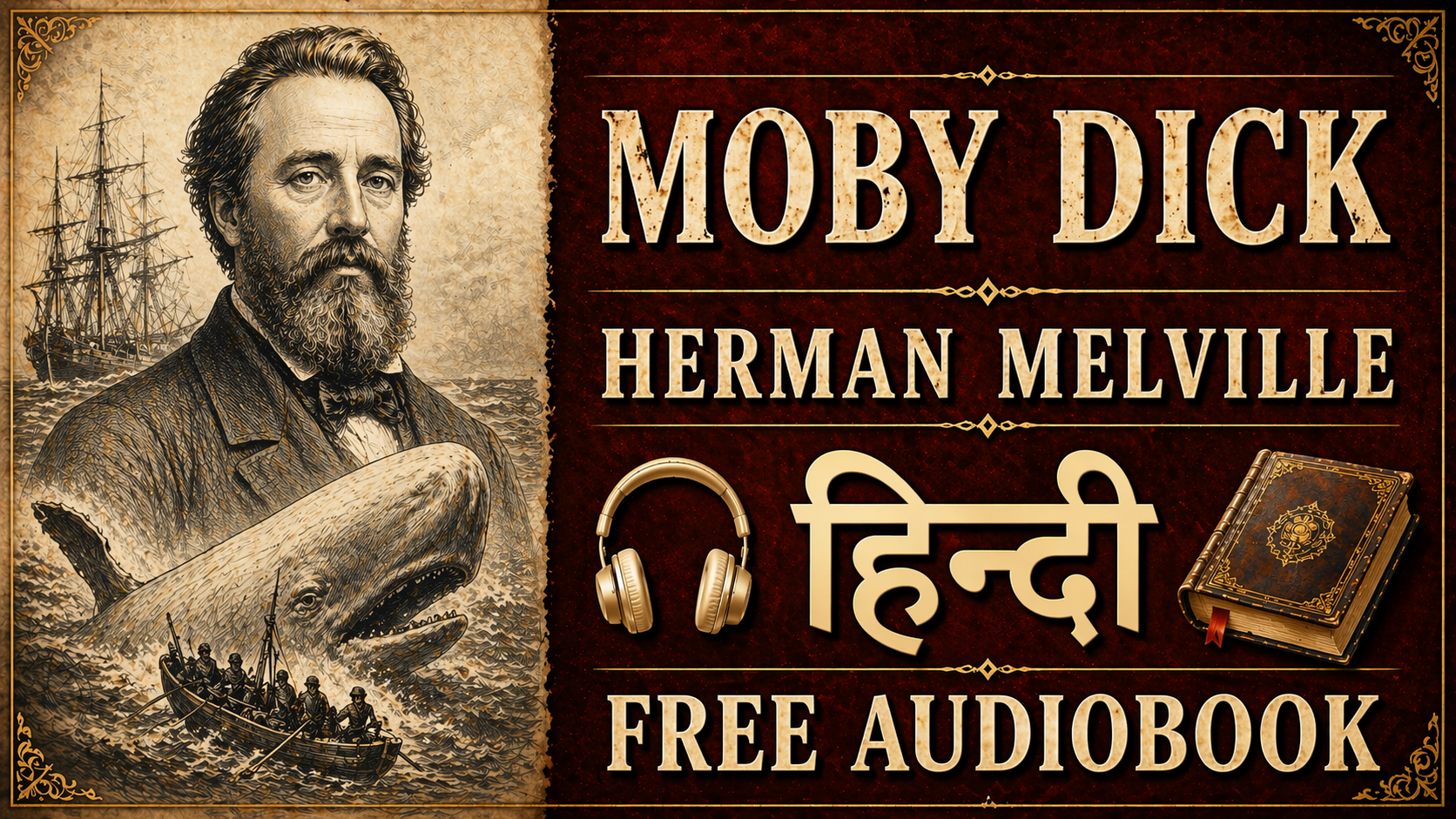
Listen to Moby Dick by Herman Melville in this complete, free Hindi audiobook covering all 135 chapters and the final epilogue of one of the greatest novels in American literature.
What happens when a man becomes so obsessed with revenge that he risks everything to achieve it?
Can human determination overcome the power of nature? And what happens when a leader's personal obsession puts everyone around him in danger?
Moby Dick tells the unforgettable story of Captain Ahab, a whaling ship captain determined to hunt down a giant white sperm whale that took his leg during an earlier encounter.
The story is narrated by Ishmael, a sailor who joins the whaling ship Pequod and discovers that what appears to be an ordinary voyage has a far more dangerous purpose.
Through terrifying ocean adventures, unforgettable characters, philosophical reflections, and a dramatic final confrontation, the novel explores revenge, obsession, friendship, fate, leadership, and the relationship between humanity and nature.
Our complete Hindi audiobook is divided into three long recordings and one separate epilogue, with a combined listening time of exactly 26 hours and 58 minutes.
You can listen to all four recordings for free on YouTube or Spotify.
Listen to Moby Dick on YouTube
Our complete Moby Dick Hindi audiobook is available on YouTube, covering Chapters 1–135 and the final epilogue.
The three main recordings follow the novel in order. A short fourth recording provides the conclusion.
Complete Moby Dick YouTube Playlist – All 135 Chapters
Prefer listening chapter by chapter?
Our dedicated YouTube playlist lets you follow the entire audiobook at your own pace.
Listen to Moby Dick – Complete Hindi Audiobook YouTube Playlist
Part 1 – Ishmael, Captain Ahab and the Beginning of the Voyage
Chapters 1–38 | Listening time: 8 hours 37 minutes
The story begins with one of the most famous openings in world literature: "Call me Ishmael."
Ishmael is a restless young man who decides to go to sea when life on land no longer interests him.
He travels to New Bedford, where he stays at an inn and meets Queequeg, an experienced harpooner from the South Pacific.
Despite their very different backgrounds, the two become close friends.
They eventually travel to Nantucket and sign aboard the Pequod, a whaling ship preparing for a long voyage.
But the ship's captain, Ahab, remains a mysterious figure.
When Ahab finally appears, the crew discovers that he has lost one of his legs and walks with an artificial leg made from whale bone.
Ahab reveals that he is searching for Moby Dick, a giant white sperm whale that injured him during a previous encounter.
He offers a gold coin to the first crew member who spots the whale and encourages the sailors to join his personal quest for revenge.
The ship's first mate, Starbuck, questions Ahab's decision to pursue revenge instead of the commercial purpose of the voyage.
Yet Ahab's determination begins to dominate the ship.
The first part introduces the main characters, whaling life, the dangers of the ocean, and the obsession that will shape everything that follows.
Important chapters include:
- Chapter 1: Loomings – Ishmael introduces himself.
- Chapter 3: The Spouter-Inn – Ishmael's unusual encounter with Queequeg.
- Chapter 10: A Bosom Friend – Their friendship develops.
- Chapter 16: The Ship – The search for a whaling vessel.
- Chapter 28: Ahab – The mysterious captain appears.
- Chapter 32: Cetology – Ishmael discusses whale classifications.
- Chapter 36: The Quarter-Deck – Ahab reveals his determination to hunt Moby Dick.
- Chapters 37–38: Sunset and Dusk – The psychological conflict surrounding Ahab's obsession deepens.
Listen to Part 1 (embedded):
Listen to Part 1:
Watch Moby Dick Part 1 – Full Hindi Audiobook on YouTube
Part 2 – The White Whale, Dangerous Hunts and Life at Sea
Chapters 39–81 | Listening time: 9 hours 42 minutes
The second recording follows the Pequod as its voyage becomes increasingly dangerous.
Ahab's desire to find Moby Dick shapes his decisions, while the crew continues the difficult and often frightening work of whaling.
The novel explores the legend of the white whale and the different meanings that Moby Dick holds for the sailors.
For Ahab, the whale becomes more than an animal.
He treats it as an enemy representing the pain, suffering, and forces he believes are working against him.
Meanwhile, Ishmael reflects on the strange power of the color white, the history of whaling, and the mysteries of life beneath the ocean.
The crew experiences its first major whale hunts, encounters other ships, and faces the dangerous realities of hunting enormous animals from small boats.
One important development is the appearance of Fedallah, a mysterious figure connected to Ahab and his private boat crew.
The novel also introduces memorable episodes involving Stubb, Flask, Starbuck, and the practical work of processing whales aboard the ship.
As the Pequod encounters other whaling vessels, the crew hears stories about the dangers of the sea and the mysterious white whale.
These encounters gradually build anticipation for the confrontation Ahab is determined to force.
Important chapters include:
- Chapter 41: Moby Dick – The history and terrifying reputation of the white whale.
- Chapter 42: The Whiteness of the Whale – Ishmael reflects on the strange emotional power of whiteness.
- Chapter 44: The Chart – Ahab studies the whale's possible movements.
- Chapter 48: The First Lowering – The crew launches its boats for a whale hunt.
- Chapter 50: Ahab's Boat and Crew, Fedallah – The mysterious crew becomes more important.
- Chapter 54: The Town-Ho's Story – Another ship's experience with Moby Dick.
- Chapter 61: Stubb Kills a Whale – A dramatic hunting episode.
- Chapter 71: The Pequod Meets the Jeroboam – A disturbing encounter with another ship.
- Chapter 81: The Pequod Meets the Virgin – Another whaling encounter at sea.
This recording combines sea adventure with detailed observations about whales, whaling practices, human psychology, and the dangerous effects of obsession.
Listen to Part 2 (embedded):
Listen to Part 2:
Watch Moby Dick Part 2 – Full Hindi Audiobook on YouTube
Part 3 – Ahab's Obsession and the Final Three-Day Chase
Chapters 82–135 | Listening time: 8 hours 37 minutes
The third recording brings the voyage of the Pequod toward its dramatic conclusion.
Ahab continues pursuing Moby Dick despite increasingly troubling events and warnings.
The novel explores the lives of the crew, the mysteries of whales, and the physical and emotional cost of the voyage.
One important event involves Pip, a young crew member who is left alone in the ocean during a whaling incident.
His experience changes him profoundly and becomes one of the novel's most moving examinations of loneliness and human vulnerability.
Another important development concerns Queequeg, who becomes seriously ill and prepares for the possibility of death.
A coffin is built for him, but he later recovers.
That coffin eventually becomes an unexpectedly important object in the story.
As the voyage continues, Ahab struggles with his damaged artificial leg, the ship faces violent weather, and the crew encounters other vessels.
A particularly significant meeting occurs with the Rachel, whose captain asks Ahab for help finding a lost whaleboat carrying his son.
Ahab refuses to abandon his pursuit of the white whale.
The novel increasingly reveals the human cost of his obsession.
Near the end, Ahab briefly reflects on his long years at sea and the life he has sacrificed.
But he remains determined to continue.
Finally, the Pequod encounters Moby Dick.
The last three numbered chapters describe the famous final chase, which unfolds over three days.
The confrontation brings Ahab's obsession to its devastating conclusion.
Important chapters include:
- Chapter 87: The Grand Armada – A dramatic encounter with a large group of whales.
- Chapter 93: The Castaway – Pip's terrible experience at sea.
- Chapter 99: The Doubloon – Crew members interpret Ahab's gold coin differently.
- Chapter 110: Queequeg in His Coffin – Illness, mortality, and the strange object that later becomes important.
- Chapter 119: The Candles – The Pequod faces a powerful storm.
- Chapter 128: The Pequod Meets the Rachel – Ahab refuses to interrupt the search for Moby Dick.
- Chapter 132: The Symphony – Ahab reflects on his life and choices.
- Chapter 133: The Chase – First Day.
- Chapter 134: The Chase – Second Day.
- Chapter 135: The Chase – Third Day.
The recording ends with the final confrontation between Ahab, the Pequod, and Moby Dick.
Listen to Part 3 (embedded):
Listen to Part 3:
Watch Moby Dick Part 3 – Full Hindi Audiobook on YouTube
Epilogue – What Happened After the Final Chase?
Listening time: 1 minute 48 seconds
The epilogue is the short final section of Moby Dick, following Chapter 135.
It explains how Ishmael survives the destruction of the Pequod and lives to tell the story.
After the ship sinks, Ishmael finds himself alone in the ocean.
A strange object rises to the surface: the coffin originally built for Queequeg.
The coffin, later adapted into a life buoy, keeps Ishmael afloat.
He remains at sea for approximately a day and a night until another ship, the Rachel, rescues him.
This short conclusion provides an important explanation for the novel's narration.
It also creates one of the book's most memorable symbols: an object originally associated with death becomes the means of saving a life.
Listen to the Epilogue (embedded):
Listen to the Epilogue:
Watch Moby Dick Epilogue – Final Hindi Audiobook Ending on YouTube
For the complete experience, listen to Parts 1, 2, and 3 in order, followed by the epilogue.
Listen to Moby Dick on Spotify
Prefer listening on Spotify?
You can also enjoy Moby Dick in Hindi on Spotify, with all three main recordings and the separate epilogue.
Follow the story in order using the links below.
Complete Moby Dick Spotify Playlist
Our Spotify playlist provides a convenient way to access the audiobook.
Listen to Moby Dick – Complete Hindi Audiobook Spotify Playlist
Spotify Part 1 – Chapters 1–38
Meet Ishmael, Queequeg, Captain Ahab, and the crew of the Pequod as the voyage begins and Ahab reveals his obsession with the white whale.
Listen to Moby Dick Part 1 on Spotify
Spotify Part 2 – Chapters 39–81
Continue the voyage through dangerous whale hunts, encounters with other ships, and Ahab's relentless search for Moby Dick.
Listen to Moby Dick Part 2 on Spotify
Spotify Part 3 – Chapters 82–135
Follow the increasingly dangerous voyage and experience the famous three-day final chase.
Listen to Moby Dick Part 3 on Spotify
Spotify Epilogue – The Final Ending
Discover how Ishmael survives and the story reaches its conclusion.
Listen to Moby Dick Epilogue on Spotify
We recommend listening to all three parts before the epilogue to experience the complete story in the intended order.
About Moby Dick by Herman Melville
Moby Dick; or, The Whale is a classic American novel written by Herman Melville and first published in 1851.
The novel tells the story of the whaling ship Pequod and its captain, Ahab, who is determined to hunt and kill a giant white sperm whale.
The story is narrated by Ishmael, a sailor who joins the ship and experiences its extraordinary journey.
But Moby Dick is much more than a story about hunting a whale.
The novel combines adventure, tragedy, philosophy, psychology, symbolism, religious references, and detailed descriptions of the 19th-century whaling industry.
Melville had personal experience working aboard ships, including a whaling vessel, and drew upon real maritime history when writing the novel.
The story was also influenced by accounts of encounters between whaling ships and powerful sperm whales.
Moby Dick was not immediately recognized as the masterpiece it is considered today.
Its unusual structure, philosophical passages, and detailed discussions of whales made it very different from a conventional adventure story.
Over time, however, it became one of the most influential novels in American literature.
At its heart, Moby Dick asks a difficult question:
What happens when a person's need to defeat an enemy becomes more important than their own life and the lives of everyone around them?
Core Message of Moby Dick
Obsession can give a person extraordinary determination, but when it replaces wisdom and compassion, it can lead to destruction.
Captain Ahab is strong, intelligent, experienced, and determined.
But his desire to take revenge on Moby Dick becomes more powerful than his responsibility toward his crew.
He begins to interpret the whale as a personal enemy rather than an animal acting according to its nature.
His obsession gradually influences the entire voyage.
Other people, including Starbuck, recognize the danger.
Yet Ahab continues pursuing his goal even when the consequences become increasingly serious.
The novel explores several important lessons:
- Determination is not always the same as wisdom.
- Revenge can become an obsession that controls a person's life.
- Nature does not necessarily act according to human ideas of good and evil.
- Leadership requires responsibility for other people's lives.
- Friendship can exist between people from very different backgrounds.
- Fear and uncertainty are part of the human experience.
- People sometimes create enemies out of things they do not understand.
- The desire for control can lead to dangerous decisions.
- Humility is important when facing forces beyond our understanding.
- Survival and hope can emerge from unexpected places.
Moby Dick does not offer simple answers.
Instead, it explores how human beings respond to suffering, uncertainty, the unknown, and their own limitations.
Main Characters in Moby Dick
Ishmael
The narrator of the novel.
He begins the story feeling restless and dissatisfied with life on land.
By joining the Pequod, he becomes both a participant in the voyage and an observer of its events.
His reflections on the sea, whales, friendship, and human behavior give the novel much of its philosophical depth.
Captain Ahab
The captain of the Pequod.
After losing a leg in an earlier encounter with Moby Dick, he becomes consumed by the desire for revenge.
He is a powerful but tragic character whose obsession places the entire crew in danger.
Queequeg
An experienced harpooner who becomes Ishmael's close friend.
Although the two come from very different cultures, they develop a relationship built on trust and mutual respect.
Queequeg also plays a symbolic role in the novel's final conclusion.
Starbuck
The Pequod's first mate.
He is cautious, responsible, and concerned about the dangers created by Ahab's personal obsession.
Starbuck repeatedly questions the captain's decisions and represents a more practical and morally concerned perspective.
Stubb
The ship's second mate.
He is often humorous and relaxed, even in dangerous situations.
His personality contrasts with Ahab's intensity and Starbuck's seriousness.
Flask
The ship's third mate.
He is direct, energetic, and deeply involved in the practical work of whaling.
Fedallah
A mysterious harpooner associated with Ahab.
His unusual appearance, predictions, and close connection to the captain contribute to the novel's atmosphere of fate and mystery.
Pip
A young cabin boy aboard the Pequod.
His frightening experience alone at sea becomes one of the novel's most emotional episodes.
Moby Dick
The enormous white sperm whale pursued by Ahab.
The whale is a living animal within the story, but it also becomes a powerful symbol of nature, uncertainty, fear, and the meanings human beings impose upon the world.
Key Ideas Explained Simply
Obsession Can Destroy Good Judgment
Ahab is a skilled captain, but his desire for revenge leads him to ignore serious dangers.
His story shows how focusing on one goal can become destructive when nothing else matters.
Nature Is Greater Than Human Control
The ocean and whales operate independently of human wishes.
Melville reminds us that determination does not give people unlimited power over nature.
A Leader Must Think About Others
Ahab's decisions affect everyone aboard the Pequod.
The novel shows why leadership involves responsibility, not just confidence and determination.
Friendship Can Cross Cultural Boundaries
Ishmael and Queequeg come from different worlds.
Their friendship is built through shared experience, kindness, and trust.
Their relationship challenges assumptions about people who appear unfamiliar or different.
We Often Give Our Fears a Face
For Ahab, Moby Dick becomes the symbol of everything he hates and fears.
He treats the whale as though it possesses a personal desire to harm him.
The novel asks whether people sometimes project their emotions onto things they cannot understand.
Knowledge Does Not Remove Uncertainty
Ishmael spends considerable time discussing whales, the sea, and whaling practices.
Yet even with extensive knowledge, the world remains mysterious.
The novel suggests that some questions may not have simple answers.
The Meaning of an Event Depends on Perspective
Different members of the Pequod's crew see the same objects and events in different ways.
Ahab sees the white whale as an enemy.
Others see it as an animal, a danger, or an opportunity.
The novel demonstrates how personal beliefs influence our interpretations.
A Goal Is Not Always Worth Its Cost
Ahab's entire life becomes organized around finding Moby Dick.
But the closer he comes to achieving his goal, the more he risks losing.
The story asks whether winning can still be considered success when the cost is too great.
Hope Can Come from Unexpected Places
The epilogue presents one of the most memorable symbols in the novel.
A coffin built in anticipation of death becomes the object that saves Ishmael.
It reminds us that meaning and hope can emerge from circumstances that initially appear hopeless.
Core Themes of Moby Dick
The novel explores:
- Revenge and obsession
- Human beings versus nature
- Fate and free will
- Leadership and responsibility
- Friendship and loyalty
- Isolation and loneliness
- Fear of the unknown
- Knowledge and uncertainty
- Life and death
- Mortality
- Religion and symbolism
- Human pride
- Madness
- Survival
- Hope
- The dangers of uncontrolled ambition
- The search for meaning
- The power of the ocean
- The relationship between humans and animals
- The limits of human understanding
These themes make Moby Dick more than a historical sea adventure.
It is also a philosophical novel about the human condition.
Famous Opening Line from Moby Dick
"Call me Ishmael."
Few novels begin with a line as famous as this one.
The simple introduction immediately creates a personal connection between Ishmael and the reader.
Yet it also raises questions.
Why does the narrator choose to introduce himself this way?
What kind of person is he?
And why does he decide to leave ordinary life behind and travel across the ocean?
As the story develops, Ishmael becomes more than a sailor telling an adventure.
He becomes a thoughtful observer of people, nature, beliefs, and the mysteries of existence.
His presence gives the novel its distinctive voice.
Frequently Asked Questions About Moby Dick
Is the Moby Dick Hindi audiobook free?
Yes. All three main recordings and the separate epilogue are available for free on our YouTube channel.
Who wrote Moby Dick?
Moby Dick was written by Herman Melville, an American novelist, short-story writer, and poet.
When was Moby Dick published?
Moby Dick was first published in 1851.
It appeared in Britain as The Whale and in the United States as Moby-Dick; or, The Whale.
How many chapters does Moby Dick have?
The novel contains 135 numbered chapters followed by a short epilogue.
Our Hindi audiobook includes all 135 chapters and the epilogue.
How long is the complete Moby Dick Hindi audiobook?
The four YouTube recordings total exactly 26 hours and 58 minutes.
Is Moby Dick one book or three books?
Moby Dick is one novel.
Our Hindi audiobook is divided into three main recordings and one separate epilogue for convenient listening.
What is Moby Dick about?
The story follows the whaling ship Pequod and Captain Ahab, who is determined to hunt down a giant white sperm whale.
The voyage is narrated by Ishmael, one of the crew members.
Who is Captain Ahab?
Captain Ahab is the captain of the Pequod.
He lost a leg during an earlier encounter with Moby Dick and becomes obsessed with taking revenge on the whale.
Who is Ishmael?
Ishmael is the novel's narrator.
He joins the Pequod as a sailor and tells the story of its voyage.
What kind of whale is Moby Dick?
Moby Dick is a large white sperm whale.
Is Moby Dick based on a true story?
It is a fictional novel inspired partly by real whaling history, Herman Melville's maritime experiences, and accounts of dangerous encounters between sperm whales and whaling ships.
What does the white whale symbolize?
The whale can represent several ideas, including the power of nature, the unknown, fear, and the meanings people project onto the world.
Its meaning is intentionally open to interpretation.
What is the main message of Moby Dick?
One important message is that obsession and revenge can become destructive when they overpower wisdom, compassion, and responsibility.
Is Moby Dick difficult to understand?
Some sections can be challenging because the novel includes philosophical reflections, historical whaling information, symbolism, and unusual storytelling techniques.
The Hindi audiobook provides another way to experience the story without reading the original English text.
Why is there a separate epilogue?
The epilogue follows Chapter 135 and explains how Ishmael survives the final events.
It provides the final conclusion to the story.
Can I listen to Moby Dick on Spotify?
Yes. All three main parts and the epilogue are linked in our Spotify listening section.
Is Moby Dick in the public domain?
The original 1851 novel is in the public domain in many countries, including the United States.
Modern translations and audiobook recordings can have separate copyright protection.
Why Moby Dick Still Matters Today
More than 170 years after its publication, Moby Dick remains one of the most discussed novels in American literature.
Its story takes place aboard a 19th-century whaling ship, but the questions it raises are still relevant.
What happens when someone becomes obsessed with one goal?
How much should a person sacrifice to achieve success?
When does determination become stubbornness?
And what responsibilities do leaders have toward the people who depend on them?
Captain Ahab is an extraordinary character because he possesses many qualities that people often admire.
He is experienced, courageous, intelligent, determined, and capable of inspiring others.
But these strengths become dangerous when his personal obsession begins controlling every decision.
He refuses to reconsider his goal.
He ignores warnings.
And he allows his desire for revenge to become more important than the safety of his crew.
This makes Moby Dick relevant to modern discussions about leadership, ambition, business, and personal relationships.
Determination can help people overcome challenges.
But determination without reflection can also lead to serious mistakes.
The novel reminds us that a person can be extremely confident and still be wrong.
It also explores our relationship with uncertainty.
Human beings often want clear answers.
We want to understand why difficult things happen.
We want to believe that every event has a reason we can identify and control.
Ahab attempts to give his suffering a clear explanation by turning Moby Dick into a personal enemy.
Yet the whale does not necessarily understand or share his hatred.
This creates one of the novel's deepest philosophical questions.
Are we responding to the world as it actually exists, or to the meaning we have created in our own minds?
Ishmael offers a different perspective.
Instead of trying to control everything, he observes, learns, questions, and reflects.
He develops a friendship with Queequeg, becomes curious about the natural world, and recognizes how much remains unknown.
The contrast between Ishmael and Ahab is central to the novel.
One character is driven by the desire to impose his will upon the world.
The other seeks to understand the world, even when it remains mysterious.
The final epilogue adds another layer of meaning.
An object made for death becomes an instrument of survival.
The story's ending reminds us that life can produce unexpected outcomes, and that survival may depend on forces beyond our plans.
Perhaps that is why Moby Dick remains powerful today.
It is not simply a story about a captain hunting a whale.
It is a story about obsession, fear, ambition, leadership, uncertainty, and the limits of human control.
And it asks a question that is relevant to anyone pursuing an important goal:
Is the thing we are chasing worth everything we might lose along the way?
Explore More Free Hindi Audiobooks
At Free Hindi Audiobooks, we're building a growing collection of classic literature, philosophy, history, and personal development books available in Hindi.
Our goal is to make the world's great books and valuable ideas accessible to Hindi-speaking listeners without financial barriers.
Whether you enjoy historical adventures, philosophical novels, romantic stories, or classic literature, there's always another book worth discovering.
Listen Next: The Odyssey by Homer
If you enjoyed Moby Dick, we recommend The Odyssey by Homer, another great literary work centered on a long and dangerous journey across the sea.
Like Moby Dick, The Odyssey features extraordinary ocean adventures, powerful natural forces, dangerous encounters, and difficult questions about courage and human limitations.
The story follows Odysseus as he struggles to return home after the Trojan War.
Along the way, he faces storms, monsters, gods, temptation, and situations that challenge his intelligence and determination.
Although the two stories have very different characters and endings, both explore what happens when human beings face forces greater than themselves.
While Captain Ahab becomes consumed by the pursuit of a white whale, Odysseus struggles to survive and return to the life he left behind.
Both works offer powerful reflections on determination, fate, wisdom, and the meaning of a journey.
Our complete Hindi audiobook of The Odyssey includes all 24 books of Homer's epic poem.
Listen to The Odyssey in Hindi:
The Odyssey by Homer – Complete Hindi Audiobook on YouTube
For another classic about the destructive power of revenge, you can also listen to The Count of Monte Cristo by Alexandre Dumas.
Continue exploring timeless stories, philosophy, and important ideas through our free Hindi audiobook collection.
Enjoy the story and discover what one of literature's greatest sea adventures can teach us about ambition, obsession, friendship, and human nature.