The Art of War by Machiavelli - Full Hindi Audiobook - Military Strategy, Warfare, Leadership

In this guide
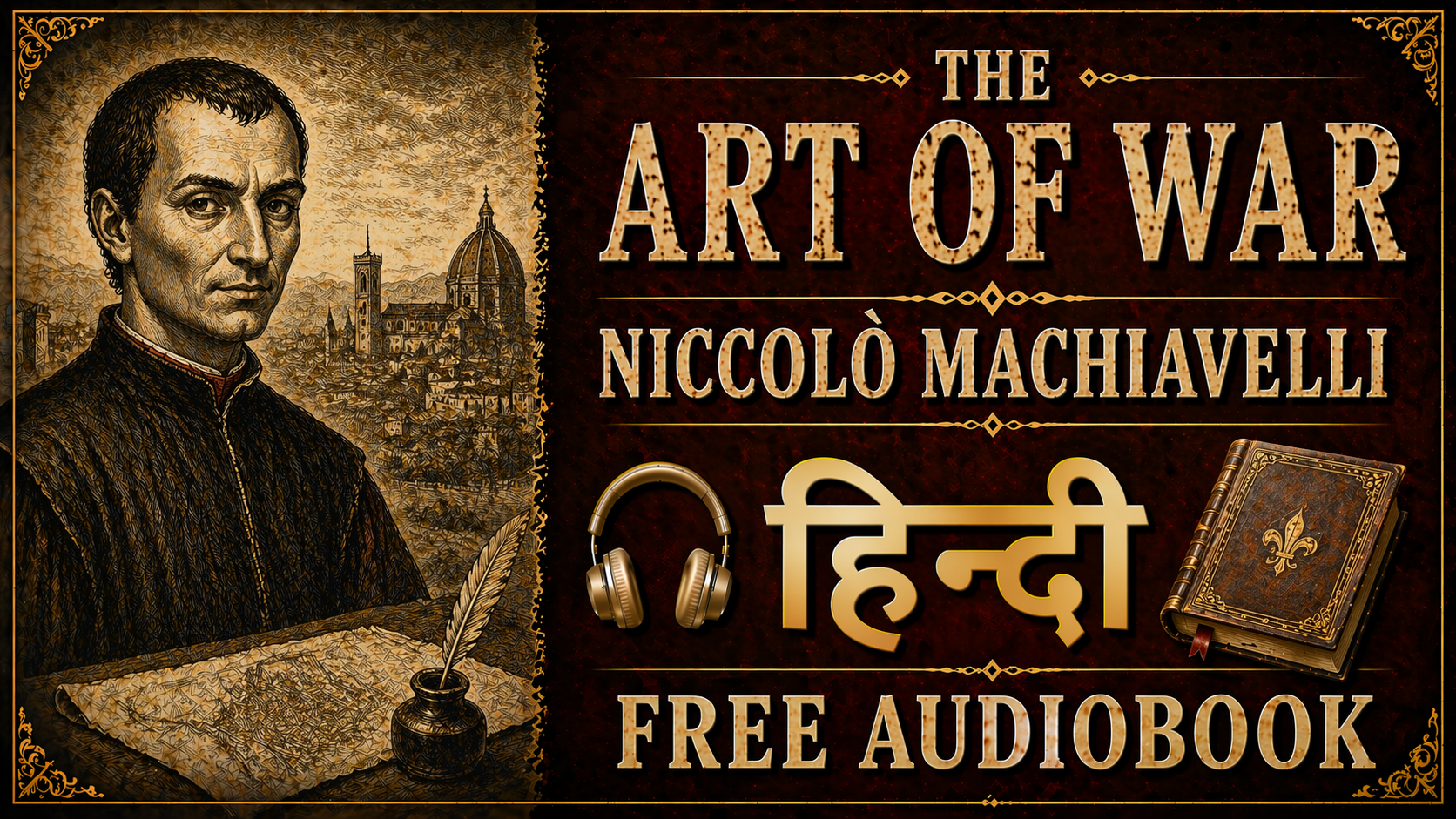
Listen to The Art of War by Niccolò Machiavelli in this complete, free Hindi audiobook featuring all seven books of his influential work on military strategy, leadership, discipline, and warfare.
What makes an army strong?
Is victory determined by the number of soldiers, the quality of their weapons, or the intelligence of their commander?
Why did Machiavelli believe that military discipline and organization were essential to the security of a nation?
Written during the Italian Renaissance and first published in 1521, The Art of War explores these questions through a detailed conversation about the organization and conduct of armies.
Machiavelli examines the military practices of ancient Rome, compares different types of soldiers, and considers the qualities needed for effective military leadership.
He discusses recruitment, weapons, training, battlefield formations, marches, camps, fortifications, and the relationship between military strength and political independence.
Unlike many books that promise quick lessons about strategy, Machiavelli's The Art of War is a detailed historical work that examines how armies function and why their organization matters.
Our complete Hindi audiobook includes all seven books, with a total listening time of approximately 8 hours and 56 minutes.
You can listen for free on YouTube or through the Spotify audiobook episode linked below.
Listen to The Art of War by Machiavelli on YouTube
Experience the complete Art of War by Niccolò Machiavelli in Hindi on our YouTube channel.
This recording presents all seven books, from the opening discussion of military institutions to the final examination of fortified cities and the qualities of a strong military system.
The Art of War – Complete Hindi Audiobook
Listening time: 8 hours, 55 minutes, 36 seconds
The audiobook follows the dialogue between the experienced military figure Fabrizio Colonna and several young Florentine gentlemen.
Their discussions explore how armies can be recruited, trained, organized, supplied, commanded, and defended.
Throughout the work, Machiavelli draws heavily on the military traditions of ancient Rome.
You will hear discussions about:
- Why Machiavelli preferred citizen soldiers to dependence on mercenaries
- How armies should be organized and trained
- The historical role of infantry and cavalry
- Weapons, armor, and battlefield formations
- Military discipline and the responsibilities of commanders
- The importance of planning and preparation
- How armies traveled through difficult or hostile territory
- Military camps and the organization of supplies
- The defense of fortified cities
- The relationship between military institutions and political stability
Listen to the complete audiobook:
The Art of War by Niccolò Machiavelli – Full Hindi Audiobook on YouTube
All Seven Books – YouTube Listening Timestamps
The audiobook is divided into seven books, with the following starting times:
- 00:00:00 – Book 1: Military institutions, recruiting soldiers, and the importance of a citizen army
- 01:34:20 – Book 2: Weapons, military equipment, training, and organization
- 03:21:40 – Book 3: Battlefield formations and the organization of armies in combat
- 04:26:32 – Book 4: Military tactics, strategy, commanders, and battlefield decisions
- 05:17:34 – Book 5: Marching armies through uncertain or hostile territory
- 06:10:23 – Book 6: Military camps, supplies, and protecting an army in the field
- 07:33:37 – Book 7: Fortifications, the defense of cities, and concluding reflections
You can listen from beginning to end or return to individual books whenever you want to explore a particular subject.
Discover More Free Hindi Audiobooks on YouTube
Our channel also offers free Hindi audiobooks of classic philosophy, literature, history, and political thought.
Browse Our Complete Free Hindi Audiobook Collection on YouTube
Listen to The Art of War by Machiavelli on Spotify
Prefer listening on Spotify?
You can also enjoy The Art of War by Niccolò Machiavelli as a complete Hindi audiobook on Spotify.
The recording explores all seven books of Machiavelli's Renaissance military treatise.
It is a convenient way to listen while traveling, walking, or learning about the history of political and military thought.
The Art of War – Full Hindi Audiobook on Spotify
Listen to the complete work and explore Machiavelli's ideas about military organization, leadership, discipline, and the importance of preparation.
Full audiobook:
The Art of War by Niccolò Machiavelli – Complete Hindi Audiobook on Spotify
About The Art of War by Niccolò Machiavelli
The Art of War, originally titled Dell'arte della guerra, is a work on military organization and strategy written by the Italian political thinker Niccolò Machiavelli.
It was published in Florence in 1521.
Machiavelli is best known for The Prince, his famous work examining political power and the behavior of rulers.
But The Art of War focuses on a closely connected subject: how states organize military forces and protect themselves.
The book is presented as a dialogue between Fabrizio Colonna, a historical Italian military commander, and a group of Florentine gentlemen.
The conversation takes place in the gardens associated with the Rucellai family in Florence.
Among the principal participants is Cosimo Rucellai, a young Florentine intellectual whose memory Machiavelli praises at the beginning of the work.
Through their discussions, Fabrizio explains his views on the strengths and weaknesses of military institutions.
Machiavelli draws extensively on the military practices of ancient Rome.
He admires the Romans for their military organization, training, discipline, and ability to connect military service with the responsibilities of citizenship.
He also questions the military systems of his own time, particularly the dependence of Italian states on hired soldiers.
The book examines military affairs in detail, including recruitment, weapons, formations, marches, fortified positions, and logistics.
But beneath these technical discussions lies a broader political argument.
A state that cannot organize and maintain its own security may become dependent on the power and interests of others.
This idea connects The Art of War to Machiavelli's wider thinking about political independence, government, and the stability of states.
Who Was Niccolò Machiavelli?
Niccolò Machiavelli (1469–1527) was an Italian diplomat, political thinker, historian, and writer from Florence.
He lived during the Renaissance, a period of major political, cultural, and intellectual change in Europe.
Italy was not a single unified country during his lifetime.
Instead, it consisted of different states, republics, principalities, and territories that frequently competed with one another.
Florence, Venice, Milan, the Papal States, and other political powers were deeply affected by shifting alliances and foreign military interventions.
Machiavelli served in the government of the Florentine Republic and gained firsthand experience with diplomacy and political affairs.
He also became involved in efforts to establish a Florentine citizen militia.
His political experiences influenced his views about the relationship between military strength and government.
Machiavelli believed that political institutions could not be understood separately from the military forces that protected them.
His best-known works include:
- The Prince
- The Art of War
- Discourses on Livy
- Florentine Histories
While The Prince examines the acquisition and maintenance of political power, The Art of War explores the organization of military power.
Both works are important for understanding Machiavelli's political thought.
Is Machiavelli's The Art of War the Same as Sun Tzu's The Art of War?
No. These are two different books written in different historical periods.
They share an English title, but their authors, structures, and approaches are different.
The Art of War by Sun Tzu
Sun Tzu's The Art of War is an ancient Chinese military treatise traditionally attributed to Sun Tzu.
It consists of 13 chapters and is famous for its compact discussions of strategy, deception, information, positioning, and the importance of understanding circumstances.
Many readers study it not only for military history but also for broader strategic thinking.
The Art of War by Machiavelli
Machiavelli's The Art of War was published in Italy in 1521.
It consists of seven books presented as a dialogue.
Its primary focus is the organization and operation of military forces.
Machiavelli examines Roman military methods, recruitment, infantry, cavalry, training, battlefield organization, marching, camps, and fortifications.
While Sun Tzu's work is often remembered for its concise strategic principles, Machiavelli provides an extended discussion of military institutions and historical practices.
Both works are important in the history of military thought, but they should not be confused.
The Hindi audiobook on this page is Niccolò Machiavelli's seven-book work.
The Core Message of The Art of War
Military strength depends on institutions, preparation, discipline, and effective leadership—not simply on having large numbers of armed men.
Throughout the dialogue, Machiavelli argues that military success requires more than courage.
An army must have a clear structure.
Its soldiers must receive training.
Commanders must understand the forces under their control.
And a political community must consider how military power is connected to its own long-term security.
Machiavelli is particularly concerned about relying on mercenaries.
In Renaissance Italy, rulers frequently employed professional soldiers whose loyalty could depend on financial arrangements and political interests.
Machiavelli questions whether a state can remain secure when it depends too heavily on military forces that do not share its political commitments.
He therefore argues for military institutions based on citizens and organized public service.
He also emphasizes the value of examining history.
For Machiavelli, ancient Rome provides examples of military discipline and organization that deserve serious study.
However, the book also reflects the weapons, political institutions, and military assumptions of the early sixteenth century.
It should be approached as a historical work rather than a modern military manual.
The lasting value of the text lies in understanding how Machiavelli connected preparation, leadership, institutions, and political independence.
Complete Listening Guide – All Seven Books
Our Hindi audiobook follows Machiavelli's original seven-book structure.
The following guide explains the central topics covered in each book.
Book 1 – Military Organization, Citizenship and Recruitment
Starts at 00:00:00
The first book begins with Machiavelli's introductory reflections and introduces the dialogue's participants.
Fabrizio Colonna becomes the principal speaker.
The conversation explores the relationship between military service and the political community.
One of the central questions is whether a state should depend primarily on hired soldiers or organize military forces drawn from its own population.
Fabrizio discusses the recruitment of soldiers and the characteristics considered important when building an army.
The book also examines the historical Roman military system and the political significance of military organization.
An important idea emerges:
A military institution cannot be judged only by the number of soldiers it contains.
Its quality also depends on how those soldiers are selected, organized, and connected to the society they serve.
Book 2 – Weapons, Training and the Structure of an Army
Starts at 01:34:20
The second book examines military equipment and training in greater detail.
Fabrizio discusses the weapons and protective equipment used by Roman soldiers.
He distinguishes between different types of infantry, including troops equipped for lighter and heavier roles.
The conversation also compares historical fighting methods and considers the advantages and limitations of different military formations.
Training becomes an important subject.
Machiavelli emphasizes that soldiers need preparation and organization rather than relying entirely on individual courage.
He is especially interested in the Roman approach to creating disciplined and coordinated military units.
This book shows why Machiavelli considered military effectiveness to be the result of sustained preparation.
Book 3 – Battle Formations and the Organization of Combat
Starts at 03:21:40
Book Three develops the discussion of how armies are organized for battle.
The dialogue examines different formations, the coordination of units, and the importance of having an organized structure.
Roman military methods continue to provide historical examples.
Fabrizio describes the relationship between different parts of an army and considers how formations support coordinated action.
The discussion demonstrates Machiavelli's interest in military order and the ability of commanders to manage complex situations.
For students of military history, this book provides insight into how Renaissance thinkers studied and interpreted ancient battlefield organization.
Book 4 – Commanders, Tactics and Strategic Decisions
Starts at 04:26:32
The fourth book shifts further toward the decisions made by commanders.
It examines historical battles, military judgment, and the effect of changing circumstances.
The dialogue discusses the role of morale, leadership, and the ability to respond to situations that differ from initial expectations.
Historical examples help explain how different commanders approached military problems.
The discussion also considers why following a familiar method without understanding the circumstances can lead to poor decisions.
Machiavelli's wider interest in judgment and preparation becomes especially visible here.
Book 5 – Moving an Army Through Dangerous Territory
Starts at 05:17:34
The fifth book examines the difficulties of moving military forces.
Unlike the earlier discussions of armies preparing to face an enemy in a defined battle, this section considers travel through territory where the location or intentions of an opponent may be uncertain.
The dialogue discusses historical marching arrangements and the broader challenges of maintaining order while moving through unfamiliar or threatening regions.
The subject also illustrates how military activity depends on preparation beyond the battlefield itself.
Movement, communication, equipment, and the preservation of an organized force all contribute to the larger historical discussion.
Book 6 – Military Camps, Supplies and Organization
Starts at 06:10:23
The sixth book focuses on the organization of military camps and the practical requirements of supporting an army.
Fabrizio describes the layout of camps, the arrangement of military units, and the importance of maintaining an orderly environment.
The discussion also touches on supplies and other necessities that allow military forces to remain functional over time.
This book highlights a less dramatic but important historical reality.
Armies require organization even when they are not actively fighting.
The condition of military institutions depends partly on the ability to manage routine responsibilities.
Machiavelli treats these concerns as central to military effectiveness, rather than as unimportant details.
Book 7 – Fortifications, Defense and the Final Lessons
Starts at 07:33:37
The final book examines fortified cities and defensive military structures.
Fabrizio discusses historical and contemporary approaches to protecting towns and strongholds.
The conversation considers how geography, buildings, walls, and military technology influenced Renaissance ideas about fortification.
The discussion also reflects changes brought about by artillery and other developments in warfare.
As the work approaches its conclusion, Fabrizio returns to broader questions about military institutions and the decline of practices he admires from antiquity.
He expresses regret that his historical and political circumstances have not allowed him to put his preferred system fully into practice.
The ending connects the technical discussions of the previous books to the larger political concerns that motivated Machiavelli's work.
Main Figures in The Art of War
Unlike a novel, The Art of War does not follow fictional characters through a continuous story.
Instead, the dialogue presents a discussion involving historical figures.
Fabrizio Colonna
Fabrizio Colonna was an Italian military commander and nobleman.
He is the principal speaker in Machiavelli's dialogue.
Through Fabrizio, Machiavelli presents detailed arguments about the organization of armies, Roman military practices, and the weaknesses he sees in contemporary military institutions.
His role is central to nearly every discussion in the book.
Cosimo Rucellai
Cosimo Rucellai was a young Florentine intellectual associated with the gardens in which the dialogue is set.
Machiavelli praises him in the opening section.
Cosimo asks questions that help introduce the principal topics of the early books.
Luigi Alamanni
Luigi Alamanni was a Florentine writer and intellectual.
He appears as one of the participants in the discussion.
His questions help develop the dialogue's examination of military organization and historical examples.
Zanobi Buondelmonti
Zanobi Buondelmonti was another Florentine participant associated with Machiavelli's intellectual circle.
He contributes questions as the conversation moves into military operations and strategic judgment.
Giovanni Battista Della Palla
Giovanni Battista Della Palla is another participant in the dialogue.
He takes part in the later discussions as Fabrizio examines further questions about armies, camps, and defenses.
Together, these figures give the work its conversational structure.
Key Lessons from The Art of War by Machiavelli
1. Preparation Matters More Than Appearance
An army may look powerful because it has many soldiers or impressive equipment.
But outward strength does not necessarily reveal its actual capabilities.
Machiavelli emphasizes the importance of organization and preparation.
The broader lesson is that reliable performance depends on developing strong foundations.
2. Leadership Requires Knowledge
A commander cannot make sound decisions through confidence alone.
Leadership involves understanding the organization, responsibilities, and limitations of the people being directed.
This is one of the recurring ideas behind the dialogue's detailed military discussions.
3. Discipline Makes Coordination Possible
Individual courage is valuable, but large groups cannot function effectively without organization.
The book repeatedly examines how training and discipline create coordinated action.
As a modern interpretation, the idea can apply to organizations that depend on people working toward a shared purpose.
4. Institutions Are More Important Than Individuals Alone
Machiavelli does not treat military strength as a matter of finding one extraordinary commander.
He is concerned with creating systems that can endure.
The structure of recruitment, training, and organization matters because it shapes what people can accomplish together.
5. Learn from History Without Copying It Blindly
Ancient Rome is a major source of examples throughout the work.
Machiavelli examines Roman practices because he believes they contain valuable lessons.
Modern readers, however, should also recognize the historical limitations of these comparisons.
The useful principle is to study why a system worked in its own circumstances rather than copying every detail.
6. Long-Term Security Requires Planning
Machiavelli connects military organization to the survival of political communities.
His argument suggests that security cannot depend entirely on temporary solutions or favorable circumstances.
A state must consider the institutions on which its protection relies.
7. Logistics and Routine Work Matter
Some of the most detailed sections of the book concern camps, supplies, and military organization away from the battlefield.
These discussions remind readers that visible achievements often depend on less visible preparation and maintenance.
8. Judgment Must Adapt to Circumstances
Historical circumstances do not remain fixed.
The book includes discussions of changing weapons, formations, and military conditions.
Its broader value lies partly in examining how judgment and preparation interact with changing situations.
9. Power and Responsibility Are Connected
Military power affects the independence and stability of political communities.
Machiavelli encourages readers to examine who controls military institutions and whose interests those institutions serve.
10. Strong Organizations Need Shared Purpose
One of Machiavelli's central concerns is the connection between soldiers and the political community.
He questions systems that depend on forces whose interests may differ from those of the state they are employed to defend.
This creates a wider lesson about responsibility, incentives, and shared commitments.
The Art of War and The Prince – How Are They Connected?
Machiavelli's The Prince and The Art of War examine different aspects of political power.
The Prince, written in the early sixteenth century and published posthumously in 1532, explores how rulers gain, maintain, and sometimes lose political authority.
It discusses leadership, political circumstances, reputation, force, alliances, and the challenges of governing.
The Art of War, published in 1521, focuses on military institutions.
Its central concerns include recruitment, training, army organization, historical military methods, and the relationship between military force and political independence.
The works are closely related because Machiavelli believed that governments could not ignore the military foundations of their power.
A ruler might possess political authority, but that authority could become vulnerable without dependable institutions.
The two works also demonstrate Machiavelli's interest in historical examples and practical political questions.
If you want to understand his ideas more broadly, listening to both works provides a useful introduction.
Is The Art of War Still Relevant Today?
Many of the military practices described in The Art of War belong to the ancient and Renaissance worlds.
Modern warfare is dramatically different.
Technological developments, political institutions, international law, communications, and the nature of military organizations have changed substantially.
For that reason, Machiavelli's descriptions should not be treated as modern military instructions.
However, the work remains valuable for understanding political and military history.
It reveals how a major Renaissance thinker interpreted the military experience of ancient Rome.
It also shows the political concerns of an Italy divided among competing states and influenced by powerful foreign governments.
Beyond its historical importance, the book raises questions that remain relevant to the study of leadership and institutions.
How does an organization prepare for uncertainty?
Why does training matter?
How can people coordinate effectively?
What happens when a government depends on organizations whose interests are not aligned with its own?
Why is it important to distinguish temporary advantages from lasting institutional strength?
These questions can be examined in many historical and organizational contexts.
The enduring value of The Art of War comes not from treating its military details as timeless instructions, but from understanding how Machiavelli connected organization, responsibility, and political power.
Frequently Asked Questions About The Art of War by Machiavelli
Is The Art of War by Machiavelli available as a free Hindi audiobook?
Yes. Our complete seven-book Hindi audiobook is available for free on YouTube.
You can also access the Spotify audiobook episode linked earlier in this article.
Who wrote The Art of War discussed on this page?
The book was written by Niccolò Machiavelli, the Italian political thinker who also wrote The Prince.
When was Machiavelli's The Art of War published?
It was first published in Florence in 1521.
How many books are in The Art of War by Machiavelli?
The work is divided into seven books.
Our complete Hindi recording includes all seven.
How long is the Hindi audiobook?
The complete recording lasts 8 hours, 55 minutes, and 36 seconds.
Is Machiavelli's The Art of War the same as Sun Tzu's book?
No. They are separate works with different authors, historical backgrounds, and structures.
Machiavelli's book is a seven-part Renaissance military dialogue.
Sun Tzu's book is an ancient Chinese military treatise traditionally organized into 13 chapters.
What is The Art of War by Machiavelli about?
It examines the organization of armies, recruitment, training, discipline, historical military methods, battlefield formations, marches, camps, and fortified cities.
Who is Fabrizio Colonna?
Fabrizio Colonna was an Italian military commander who serves as the principal speaker in Machiavelli's dialogue.
Is The Art of War a story or a nonfiction book?
It is a work of political and military thought written in dialogue form.
It is not a fictional adventure novel, although it contains conversations and historical examples.
Why does Machiavelli discuss ancient Rome so often?
Machiavelli admired several features of Roman military organization, especially its connection to public institutions, recruitment, training, and discipline.
He uses Roman history to examine what he considered the strengths and weaknesses of military systems.
What does Machiavelli say about mercenary soldiers?
He questions the reliability of depending on hired forces whose interests may not align with those of the political community.
He favors military institutions more directly connected to the state and its citizens.
Is the book useful for learning about leadership?
It can be useful for studying historical ideas about leadership, preparation, organization, and responsibility.
However, many of its discussions are specifically about early modern military institutions.
Is The Art of War suitable for beginners?
Yes, although it is more detailed and technical than many popular books on strategy.
Listeners interested in history and political philosophy may find it especially rewarding.
Is The Art of War by Machiavelli in the public domain?
The original Renaissance work is in the public domain.
Modern translations and recordings may have separate copyright protection.
Where can I listen to The Art of War in Hindi?
You can listen through the full YouTube audiobook or the Spotify episode linked near the beginning of this article.
Why Machiavelli's The Art of War Still Matters
More than five centuries after its publication, The Art of War remains an important work for understanding how military organization influenced political thought during the Renaissance.
Machiavelli lived in an era when the independence of Italian states was frequently threatened by war and foreign intervention.
He believed that political institutions could not remain secure without serious attention to the military forces on which they depended.
His work therefore examines a fundamental relationship between political authority and organized force.
But it also reveals a broader interest in institutions.
Machiavelli does not describe military success as simply the result of courage, aggression, or a single talented leader.
He gives sustained attention to recruitment, training, organization, and routine preparation.
For readers interested in the history of leadership, this is one of the book's most interesting qualities.
The discussion also shows the intellectual influence of ancient Rome on Renaissance political thinkers.
Machiavelli believed the ancient world contained lessons that his contemporaries had neglected.
His efforts to recover those lessons formed part of a wider Renaissance interest in classical history and literature.
Yet modern readers can also question his assumptions.
Not every Roman practice was ideal, and institutions that worked in one historical period may not be appropriate in another.
Studying Machiavelli therefore involves both understanding his arguments and examining their limitations.
This is what makes The Art of War valuable as a work of historical and political thought.
It offers insight into how one of the Renaissance's most influential thinkers understood the connection between military preparation, political institutions, and the independence of states.
Explore More Free Hindi Audiobooks
At Free Hindi Audiobooks, we are building a growing collection of classic books on literature, philosophy, history, politics, and personal development.
Our goal is to make important works accessible to Hindi-speaking audiences for free.
If you enjoyed Machiavelli's The Art of War, we recommend listening to another influential book by the same author.
Listen Next: The Prince by Niccolò Machiavelli
The Prince is one of the most famous works of political philosophy in history.
While The Art of War examines military organization, The Prince explores the acquisition, exercise, and preservation of political power.
Machiavelli discusses the responsibilities and difficulties of leadership, the importance of political judgment, and the challenges rulers face when circumstances change.
Both books help readers understand how Machiavelli approached political life.
In The Prince, the focus is on the ruler and the exercise of power.
In The Art of War, the focus moves toward military institutions and their relationship with political stability.
Listening to both provides a broader introduction to Machiavelli's ideas.
Listen to The Prince in Hindi:
The Prince by Niccolò Machiavelli – Full Hindi Audiobook on YouTube
Another Recommendation: Arthashastra by Kautilya
If you are interested in political strategy and the history of government, you may also enjoy Arthashastra, traditionally associated with Kautilya, also known as Chanakya.
Arthashastra examines ancient Indian ideas about administration, economics, government, diplomacy, and political power.
Although it comes from a very different historical and cultural tradition, it raises some questions that are also relevant to the study of Machiavelli.
Both works explore the relationship between political leadership and the practical responsibilities of government.
Listen to Arthashastra in Hindi:
Arthashastra by Kautilya – Full Hindi Audiobook
Continue exploring timeless works of literature, history, and philosophy through our free Hindi audiobook collection.
Listen, learn, and discover how some of history's most influential thinkers understood leadership, power, and the challenges of human society.