The Gospel of Wealth Hindi Audiobook - Andrew Carnegie’s Philosophy of Wealth and Duty
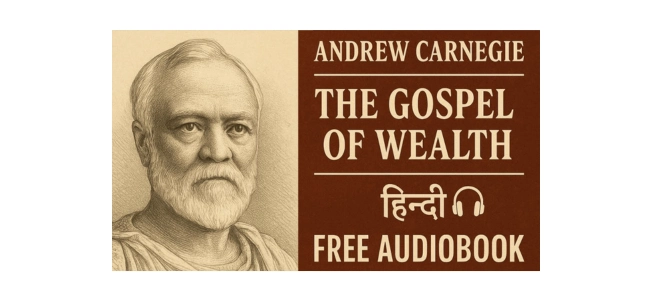
-
Listen to the Full Hindi Audiobook Below
-
Listen on Spotify
-
About The Gospel of Wealth by Andrew Carnegie
-
Core Message of The Gospel of Wealth
-
Chapters and Listening Guide
- Wealth and Inequality
- The Moral Responsibility of the Wealthy
- Against Leaving Wealth to Heirs
- The Problem with Traditional Charity
- The Proper Use of Wealth
- Wealth as a Tool for Progress
- Living Modestly, Giving Actively
- The Duty to Act During One’s Lifetime
- The Ideal Wealthy Individual
-
Core Ideas and Themes
-
Famous Quotes from The Gospel of Wealth
-
FAQ
-
Explore More Free Hindi Audiobooks
Disclosure: Some of the links in this article may be affiliate links, which can provide compensation to me at no cost to you if you decide to purchase. This site is not intended to provide financial advice and is for entertainment only.
Listen to the Full Hindi Audiobook Below
This is the full free Hindi audiobook of The Gospel of Wealth by Andrew Carnegie.
You can listen anytime and at your own pace.
The audiobook is narrated in clear, simple, and practical Hindi, making Carnegie’s powerful philosophy on wealth, responsibility, and society easy to understand and deeply applicable in real life.
YouTube Audiobook:
Listen on Spotify
You can also enjoy this audiobook on Spotify. Many listeners prefer Spotify for long audiobooks and repeated listening.
Spotify Link (the book starts on 17:43)
Listen to The Gospel of Wealth by Andrew Carnegie on Spotify (Hindi Audiobook)
About The Gospel of Wealth by Andrew Carnegie
The Gospel of Wealth is not a guide on how to accumulate money, but a guide on how wealth should be used once it has been created.
In this influential essay, Andrew Carnegie presents a powerful moral argument: that great wealth carries great responsibility. According to Carnegie, individuals who accumulate large fortunes do not truly own surplus wealth, they hold it in trust for society.
The book argues that:
Extreme wealth inequality is a natural outcome of industrial progress
Hoarding wealth is morally wrong
Blind charity weakens society
Wise redistribution strengthens civilization
Carnegie emphasizes that wealth should be used to create opportunity, not dependency. Education, libraries, public institutions, and systems that help people help themselves are presented as the highest and most ethical uses of money.
Core Message of The Gospel of Wealth
Carnegie argues that great wealth is a trust, not a personal possession.
According to him:
Extreme inequality is a natural result of progress
But hoarding wealth is morally wrong
The rich have a duty to redistribute surplus wealth wisely
Charity should empower, not weaken
True success is measured not by how much one accumulates, but by how wisely one returns wealth to society.
Chapters and Listening Guide
This Hindi audiobook is structured as a series of tightly connected ideas rather than traditional chapters. Each section addresses wealth, power, and moral responsibility.
Wealth and Inequality
Carnegie begins by acknowledging that modern society creates vast inequalities. He argues that this inequality is the price paid for civilization, innovation, and progress. While uncomfortable, it enables efficiency and advancement. The real issue is not inequality itself, but how surplus wealth is handled.
The Moral Responsibility of the Wealthy
According to Carnegie, the rich act as trustees of societal wealth. They hold excess resources temporarily and must return them in ways that benefit the community. Personal luxury beyond reasonable comfort is wasteful. Wealth gains moral value only when used for public good.
Against Leaving Wealth to Heirs
Carnegie strongly criticizes large inheritances. He believes that giving children excessive wealth weakens their character, ambition, and discipline. True love for one’s family lies in education, values, and guidance, not unearned riches.
The Problem with Traditional Charity
Blind charity, Carnegie argues, often does more harm than good. Giving money without purpose can encourage dependence and idleness. True generosity strengthens self-reliance and capability. Help should lift people up, not trap them in weakness.
The Proper Use of Wealth
Carnegie outlines the correct use of surplus wealth:
Building libraries
Supporting education
Advancing science and culture
Creating public institutions
These investments give people tools, not handouts. They create opportunity rather than dependency.
Wealth as a Tool for Progress
Money itself is neutral. Its value depends entirely on how it is used. In wise hands, wealth becomes a force for civilization, learning, and human development. In careless hands, it becomes destructive and corrupting.
Living Modestly, Giving Actively
Carnegie emphasizes modest living even among the wealthy. Excess luxury dulls character and purpose. The true role of wealth is action, stewardship, and contribution. Giving should be thoughtful, planned, and continuous - not delayed until death.
The Duty to Act During One’s Lifetime
One of Carnegie’s strongest arguments is against dying rich. He famously states that a person who dies wealthy dies disgraced. Wealth should be distributed during life, when judgment, wisdom, and responsibility can guide its use.
The Ideal Wealthy Individual
The ideal rich person, according to Carnegie:
Lives simply
Thinks long-term
Understands society’s needs
Funds opportunity, not comfort
Acts as a guardian of progress
Such individuals elevate society rather than dominate it.
Core Ideas and Themes
Wealth is a social trust
Inequality is inevitable, misuse is not
Charity must empower, not weaken
Inheritance can destroy character
Giving is a duty, not a favor
Wealth gains meaning through service
Dying rich is a moral failure
Famous Quotes from The Gospel of Wealth
(All quotes are from public domain sources.)
“The man who dies rich dies disgraced.”
“Surplus wealth is a sacred trust to be administered for the good of others.”
“The aim of the millionaire should be to provide the means by which the aspiring can help themselves.”
“Charity that tends to increase dependence is not charity.”
“Wealth passing into the hands of the few is the condition of progress.”
FAQ
Is this audiobook free?
Yes. This Hindi audiobook is completely free to listen.
Is The Gospel of Wealth public domain?
Yes. The essay is in the public domain.
Is this audiobook suitable for beginners?
Yes. The ideas are clearly narrated in simple, thoughtful Hindi.
Is this book anti-wealth?
No. It supports wealth creation - but demands moral responsibility.
Do you offer more Hindi audiobooks like this?
Yes. We are building a growing library focused on philosophy, discipline, and timeless wisdom.
Explore More Free Hindi Audiobooks
We are creating a library of full-length, free Hindi audiobooks based on timeless works of wisdom.
Listen anytime, revisit important ideas, and share them with others who value discipline, clarity, responsibility, and inner strength.
Enjoy listening - and reflect deeply on how wealth, power, and purpose must walk together.
P.S. We also have detailed blog posts on other Hindi audiobooks like As a Man Thinketh by James Allen and The Way to Wealth by Benjamin Franklin and many others.
-
Listen to the Full Hindi Audiobook Below
-
Listen on Spotify
-
About The Gospel of Wealth by Andrew Carnegie
-
Core Message of The Gospel of Wealth
-
Chapters and Listening Guide
- Wealth and Inequality
- The Moral Responsibility of the Wealthy
- Against Leaving Wealth to Heirs
- The Problem with Traditional Charity
- The Proper Use of Wealth
- Wealth as a Tool for Progress
- Living Modestly, Giving Actively
- The Duty to Act During One’s Lifetime
- The Ideal Wealthy Individual
-
Core Ideas and Themes
-
Famous Quotes from The Gospel of Wealth
-
FAQ
-
Explore More Free Hindi Audiobooks
Disclosure: Some of the links in this article may be affiliate links, which can provide compensation to me at no cost to you if you decide to purchase. This site is not intended to provide financial advice and is for entertainment only.