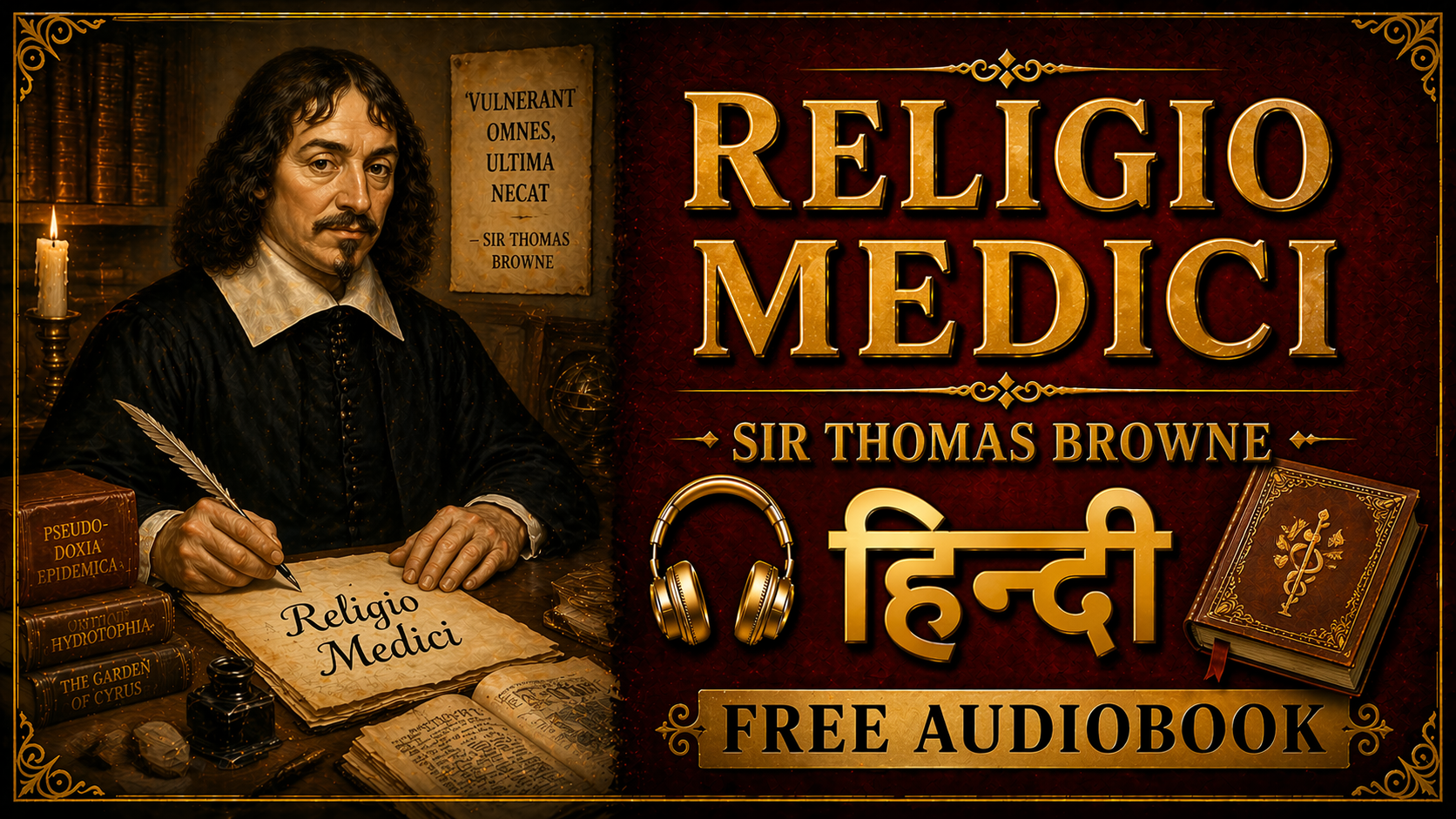
Religio Medici Full Hindi Audiobook by Sir Thomas Browne - Faith, Science & the Meaning of Life

In this guide
Listen to the Full Hindi Audiobook on YouTube
This is the complete free Hindi audiobook of Religio Medici by Sir Thomas Browne, one of the most fascinating philosophical and spiritual works of the 17th century.
What happens when a doctor, trained to understand the human body through observation and reason, begins questioning the deeper mysteries of faith, life, death, and the human soul?
Religio Medici, meaning The Religion of a Physician, explores these questions through the personal reflections of an English doctor who believed that scientific curiosity and religious faith did not necessarily have to contradict one another.
In this Hindi audiobook, you can explore Browne's thoughts about God, nature, human existence, charity, tolerance, and the limitations of human understanding.
The audiobook runs for approximately 4 hours and 4 minutes, making it ideal for thoughtful listening, quiet reflection, and exploring classical philosophy in Hindi.
YouTube embedded link:
YouTube audiobook:
Listen to Religio Medici – Complete Hindi Audiobook on YouTube
You can listen at your own pace and return to different ideas whenever you wish.
Listen on Spotify
Prefer listening on Spotify? You can also explore Religio Medici through the Spotify link below.
Whether you're relaxing, walking, traveling, or simply taking time to think, audiobook listening offers a convenient way to discover great works of philosophy and literature.
Spotify link:
Listen to Religio Medici by Sir Thomas Browne on Spotify – Hindi Audiobook
About Religio Medici by Sir Thomas Browne
Religio Medici is a philosophical and spiritual work written by Sir Thomas Browne, an English physician, author, and thinker who lived from 1605 to 1682.
The book was originally written around 1635 as a private reflection on Browne's personal beliefs.
An unauthorized edition appeared in 1642, followed by an authorized edition in 1643.
The title Religio Medici comes from Latin and means The Religion of a Physician.
But this is not a medical textbook.
Instead, it is a deeply personal exploration of how a person trained in medicine and natural observation understands religion, morality, the soul, and the mysteries of existence.
Browne lived during a time of intense religious disagreement and growing scientific investigation. Rather than accepting that faith and reason must always be enemies, he explored how they could coexist within his own understanding of the world.
Throughout the book, he reflects on:
- Faith and religious belief
- Reason and the limits of human knowledge
- The relationship between nature and God
- Life, death, and immortality
- The human soul
- Charity and compassion
- Religious tolerance
- Moral responsibility
- The mysteries of existence
Unlike a conventional philosophy textbook, Religio Medici does not present a simple system of rules.
It invites readers to enter the mind of a curious physician trying to understand his place in the universe.
This makes it a particularly interesting work for listeners who enjoy philosophy, spirituality, history, and questions about the meaning of life.
Core Message of Religio Medici
A person can search for knowledge while remaining open to mystery, and personal belief should be accompanied by compassion toward others.
This is one of the most important ideas running through Browne's reflections.
For Browne, studying the natural world did not necessarily weaken religious faith. His understanding of anatomy, medicine, and nature became part of how he contemplated existence.
But knowledge alone was not enough.
A person could possess impressive learning and still lack kindness, humility, or understanding.
Browne repeatedly returns to the importance of charity, tolerance, and moral character.
His reflections suggest that:
- Intellectual knowledge has limits.
- Faith and reason can exist in tension without always being enemies.
- Human beings should remain humble about what they do not understand.
- Compassion matters more than winning every argument.
- Death reminds us of the fragility of life.
- Religious differences do not have to destroy respect between people.
- Personal beliefs should influence how we treat others.
Religio Medici encourages us to consider not only what we believe, but also how those beliefs shape the way we live.
Structure and Listening Guide
Religio Medici is traditionally divided into two main parts, broadly concerned with faith and hope and charity.
The reflections below are a thematic listening guide rather than the book's official chapter titles.
Part One: Faith, Reason, and the Mysteries of Existence
In the first part, Browne explores his understanding of Christianity, the natural world, and the limits of human reasoning.
He examines the relationship between what we can observe and what we accept through faith.
Faith and Personal Belief
Browne reflects on his Christian identity and the role of belief in his life.
He considers what it means to believe sincerely while acknowledging that some religious mysteries cannot be fully explained through reason.
Science and Religion
As a physician, Browne was familiar with medical knowledge and the study of nature.
Rather than treating nature as separate from his religious worldview, he saw the natural world as something worthy of both investigation and wonder.
This raises an enduring question: must scientific understanding and spiritual belief always contradict one another?
Nature and the Universe
Browne is fascinated by the complexity of living things, natural forms, and the order of the universe.
He sees nature through the combined perspectives of a physician, philosopher, and believer.
The Human Soul
What makes us human?
Is a person simply a physical body, or is there something beyond material existence?
Browne reflects on the nature of the soul, spiritual identity, and the relationship between body and mind.
Readers interested in similar questions about the soul, knowledge, and moral life may also enjoy The Republic by Plato – Full Hindi Audiobook.
Life, Death, and Immortality
Death is one of the central mysteries that Browne examines.
A physician witnesses the vulnerability of the human body, yet Browne approaches mortality through his Christian belief in the soul and the afterlife.
His reflections ask readers to consider how awareness of death might change the way we value life.
Part Two: Charity, Tolerance, and Moral Character
The second part of Religio Medici turns toward the way people treat one another.
Browne examines charity as a moral and religious virtue, not simply as the act of giving money.
Charity and Compassion
For Browne, charity includes kindness, generosity, concern for others, and a willingness to recognize our shared humanity.
A person's religious convictions should not remain abstract ideas. They should influence behavior.
Tolerance and Disagreement
Browne shows a willingness to question his own opinions and avoid unnecessary conflict over differences of belief.
He recognizes that people can disagree without treating one another as enemies.
This theme remains relevant in a world where religious, political, and philosophical disagreements often create division.
Humility and Self-Reflection
Browne does not present himself as someone who understands everything.
He recognizes the complexity of human nature, including his own contradictions.
True wisdom may require admitting that our knowledge is incomplete.
Living a Good Life
The book ultimately raises a practical question:
What does it mean to live well?
Is it enough to understand the world intellectually, or must we also develop kindness, self-awareness, and moral responsibility?
For another approach to self-discipline and ethical living, explore The Enchiridion by Epictetus – Hindi Audiobook, a classic of Stoic philosophy.
Key Ideas Explained Simply
Faith and Reason Are Not Always Opposites
Browne explores how the study of nature and personal religious belief can exist together.
Knowledge Has Limits
Human beings can learn a great deal about the world, but not every question has a simple answer.
Humility Is a Form of Wisdom
Recognizing what we do not know can make us more thoughtful and open-minded.
Compassion Matters
Knowledge, faith, and intelligence lose much of their value when they are separated from kindness.
Respect Differences
People can disagree about religion and philosophy while still treating each other with dignity.
Life Is Fragile
Our awareness of mortality can encourage us to examine how we spend our time and what we consider important.
Character Matters More Than Arguments
The way a person behaves may reveal more about their values than the ideas they claim to believe.
Core Themes of Religio Medici
The main themes explored in this classic work include:
- Faith and spirituality
- Christianity and religious belief
- Science and religion
- Philosophy and reason
- The human soul
- Life and death
- Immortality and the afterlife
- Charity and compassion
- Tolerance and understanding
- Nature and creation
- Humility
- Moral responsibility
- Human identity
- The limits of knowledge
- The meaning of existence
Together, these themes make Religio Medici an unusual combination of spiritual autobiography, philosophical reflection, and moral inquiry.
Famous Lines from Religio Medici
Here are three memorable lines from Sir Thomas Browne's original work, preserving their historical wording.
1. "Nature is the Art of God."
This short statement captures Browne's view of the natural world as an expression of divine creativity.
2. "There is no road or ready way to vertue."
Moral character cannot be developed through easy shortcuts. Virtue requires personal effort and reflection.
3. "But how shall we expect charity towards others, when we are uncharitable to our selves?"
Browne raises an important question about the relationship between kindness toward ourselves and compassion for others.
These lines reflect the central themes of the book: wonder, humility, virtue, and charity.
Frequently Asked Questions About Religio Medici
Is the Religio Medici Hindi audiobook free?
Yes. You can listen to the complete Hindi audiobook on our YouTube channel for free.
Who wrote Religio Medici?
Religio Medici was written by Sir Thomas Browne, a 17th-century English physician, philosopher, and author.
What does Religio Medici mean?
The Latin title translates to The Religion of a Physician.
It refers to Browne's personal reflections on religious faith and his experiences as a physician.
When was Religio Medici published?
The book first appeared without the author's authorization in 1642. Browne published an authorized edition in 1643.
Is Religio Medici a religious book or a philosophy book?
It is both.
The work is rooted in Browne's Christian beliefs, but it also explores philosophical questions about reason, nature, knowledge, morality, and human existence.
Is Religio Medici a medical book?
No. Although its author was a physician, Religio Medici is primarily a work of personal philosophy, spirituality, and moral reflection rather than a guide to medical treatment.
Is Religio Medici suitable for beginners?
Yes, particularly for listeners interested in classical philosophy, spiritual questions, and reflective literature.
However, some of Browne's ideas and references come from the intellectual and religious world of 17th-century England, so they may require additional thought.
How long is the Hindi audiobook?
Our complete YouTube audiobook is approximately 4 hours and 4 minutes long.
Is Religio Medici in the public domain?
The original 17th-century work is in the public domain in many countries. However, modern translations, edited editions, and individual recordings may have separate rights.
What is the main lesson of Religio Medici?
One of its central lessons is that intellectual curiosity, spiritual belief, humility, and compassion can all contribute to a person's understanding of life.
The book encourages readers to examine their beliefs while remaining conscious of their responsibility toward others.
Why Religio Medici Still Matters Today
More than 380 years after its first publication, Religio Medici continues to raise questions that remain relevant.
Modern society has access to extraordinary scientific knowledge.
We can study the human body in remarkable detail, communicate across continents, and investigate the natural world with technologies Browne could never have imagined.
Yet many of the questions that concerned him remain open.
What makes life meaningful?
How should we deal with uncertainty?
Why do people disagree so deeply about religion?
Can someone value scientific knowledge while holding spiritual beliefs?
What does it mean to be a good person?
Religio Medici does not provide universally accepted answers to these questions. Instead, it allows us to examine how one thoughtful physician confronted them in his own time.
The book also encourages reflection on the relationship between knowledge and kindness.
Today, people can become experts in highly specialized fields while struggling to understand those who think differently.
Browne's emphasis on charity offers a reminder that intellectual achievement and moral character are not the same thing.
You can be knowledgeable without being compassionate.
You can hold strong beliefs without being willing to listen.
And you can spend a lifetime gathering information without taking time to ask what truly matters.
Perhaps that is why Religio Medici is still worth exploring.
It invites us to consider the mystery of existence without abandoning curiosity, and to approach other people with greater humility.
Ultimately, this is not simply a book about the religion of a physician.
It is a book about what happens when a person looks closely at the world and begins questioning their place within it.
Explore More Free Hindi Audiobooks
We are building a growing library of free Hindi audiobooks covering philosophy, spirituality, classic literature, personal development, and timeless ideas.
Our goal is simple: make great books and useful knowledge accessible to more people through free Hindi listening.
If Religio Medici interested you, I recommend exploring The Dhammapada, a collection of Buddhist teachings about the mind, compassion, morality, suffering, and inner peace.
While Sir Thomas Browne writes from a Christian perspective and the Dhammapada comes from the Buddhist tradition, both offer valuable opportunities to reflect on ethical living and how we treat others.
Listen next:
The Dhammapada – Full Hindi Audiobook | Buddha on Mind, Karma and Inner Peace
Enjoy the books, reflect on their ideas, and return whenever you feel like learning something new.