The Odyssey by Homer - Full Hindi Audiobook | All 24 Books - Greek Mythology & Adventure

In this guide
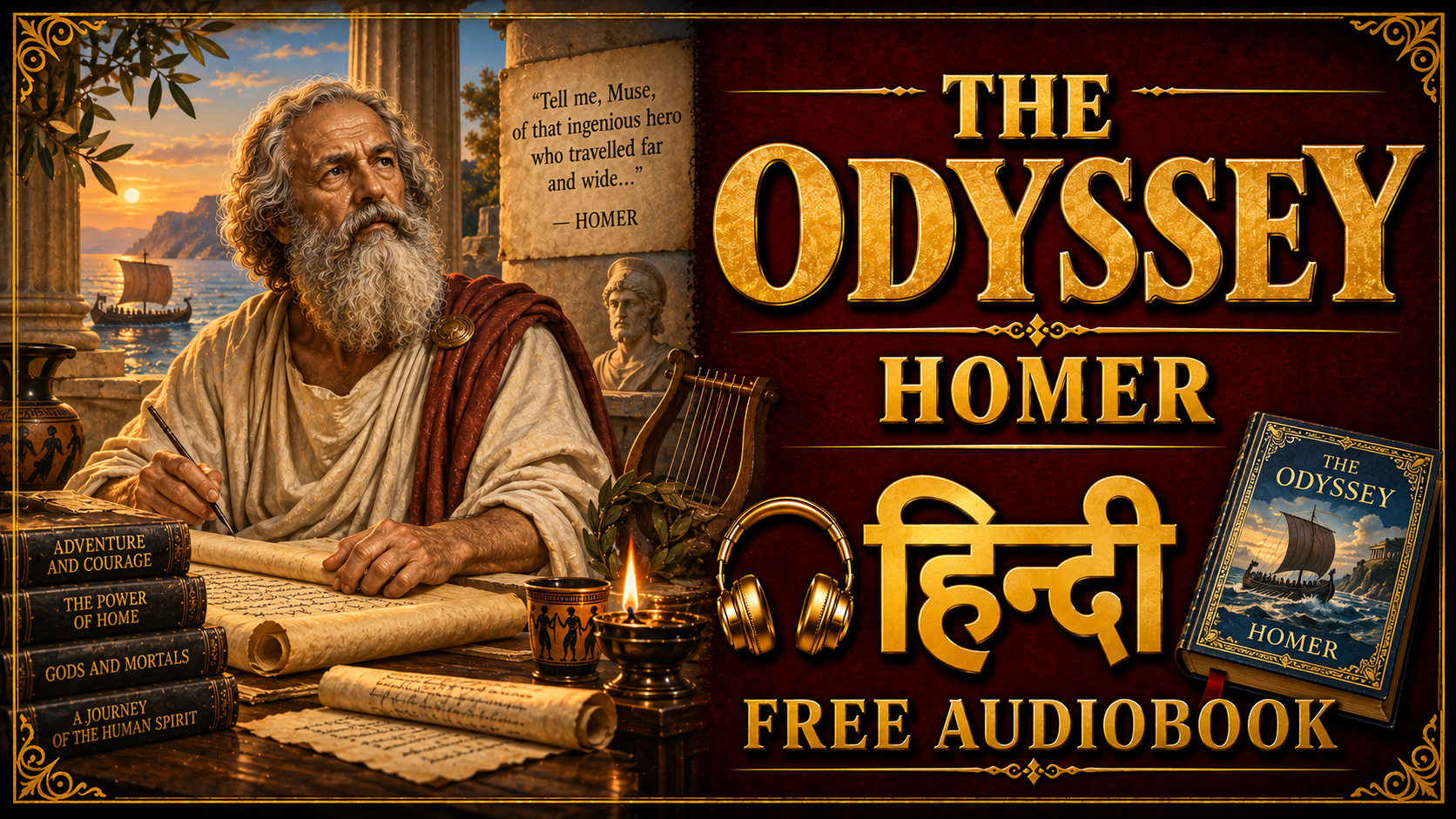
Listen to The Odyssey by Homer (होमर की ओडिसी) in this complete, free Hindi audiobook featuring all 24 books of one of the greatest adventure stories in world literature.
What would you do if it took ten years to return home after a war?
Could you survive dangerous seas, terrifying monsters, powerful gods, and the loss of almost everyone traveling with you?
And after twenty years away, would your family still recognize you?
The Odyssey tells the extraordinary story of Odysseus, the legendary Greek hero and king of Ithaca, who struggles to return home after the Trojan War.
His journey takes him across mysterious seas and into encounters with giants, enchantresses, supernatural creatures, and gods.
He faces the one-eyed Cyclops Polyphemus, the dangerous song of the Sirens, the sorceress Circe, and the terrifying creatures Scylla and Charybdis.
But The Odyssey is more than an adventure about monsters and survival.
It is also a story about loyalty, family, intelligence, courage, temptation, and the powerful human desire to return home.
While Odysseus struggles to survive, his wife Penelope waits in Ithaca, surrounded by men who want to marry her and take control of his household.
His son Telemachus grows into adulthood without knowing whether his father is alive.
For Odysseus, the greatest reward is not treasure, fame, or immortality.
It is the chance to see his family and homeland again.
Our complete Hindi audiobook includes all 24 books, with a total listening time of 11 hours, 53 minutes, and 36 seconds.
You can listen to the entire epic on YouTube or Spotify.
Listen to The Odyssey on YouTube
Experience the complete Hindi audiobook of The Odyssey on our YouTube channel.
This recording follows the original epic's 24-book structure, from the crisis in Odysseus's household to his long-awaited return and the restoration of peace in Ithaca.
The Odyssey – Complete Hindi Audiobook
Listening time: 11 hours, 53 minutes, 36 seconds
Throughout this audiobook, you will discover:
- The legendary story of Odysseus after the Trojan War
- Telemachus's search for news of his missing father
- Penelope's struggle against unwanted suitors
- The intervention of Greek gods and goddesses
- Odysseus's escape from the Cyclops Polyphemus
- His encounters with Circe, Calypso, and the Sirens
- The dangerous passage between Scylla and Charybdis
- His journey to the world of the dead
- The importance of intelligence, courage, and self-control
- Odysseus's secret return to Ithaca
- His reunion with Telemachus and Penelope
- The dramatic conclusion of his twenty-year absence
Listen to the complete audiobook:
The Odyssey by Homer – Full Hindi Audiobook on YouTube
Complete YouTube Timestamps – All 24 Books
Our recording includes every book of the original epic.
- 00:00:00 – Book 1: Athena Inspires Telemachus
- 00:25:17 – Book 2: Telemachus Challenges the Suitors
- 00:51:23 – Book 3: Telemachus Visits King Nestor
- 01:20:27 – Book 4: Menelaus, Helen and News of Odysseus
- 02:09:30 – Book 5: Odysseus Leaves Calypso's Island
- 02:38:57 – Book 6: Nausicaa Meets Odysseus
- 02:59:14 – Book 7: The Palace of the Phaeacians
- 03:20:00 – Book 8: The Phaeacian Games and Songs of Troy
- 03:54:24 – Book 9: The Cyclops Polyphemus
- 04:30:10 – Book 10: Aeolus, the Laestrygonians and Circe
- 05:05:30 – Book 11: Odysseus Visits the Underworld
- 05:43:23 – Book 12: The Sirens, Scylla and Charybdis
- 06:10:51 – Book 13: Odysseus Returns to Ithaca
- 06:37:11 – Book 14: Odysseus Meets Eumaeus
- 07:10:12 – Book 15: Telemachus Returns Home
- 07:43:20 – Book 16: Father and Son Reunited
- 08:10:41 – Book 17: Odysseus Enters His Palace in Disguise
- 08:46:31 – Book 18: The Beggar's Contest and Penelope
- 09:12:55 – Book 19: Penelope Questions the Stranger
- 09:42:42 – Book 20: The Final Preparations
- 10:05:51 – Book 21: The Contest of Odysseus's Bow
- 10:27:34 – Book 22: Odysseus Confronts the Suitors
- 10:55:02 – Book 23: Penelope and Odysseus Reunite
- 11:18:04 – Book 24: The Final Reunion and Peace in Ithaca
The descriptive titles above are provided as a listening guide. The original epic is traditionally divided into 24 numbered books.
Explore More Free Hindi Audiobooks on YouTube
Discover other classic works of literature, mythology, philosophy, and history in our growing Hindi audiobook collection.
Browse All Free Hindi Audiobooks on YouTube
Listen to The Odyssey on Spotify
Prefer listening on Spotify?
You can also enjoy The Odyssey by Homer as a complete Hindi audiobook on Spotify.
Follow Odysseus from the aftermath of the Trojan War through his dangerous adventures and eventual return to Ithaca.
The audiobook combines Greek mythology, heroic adventure, family loyalty, and important reflections on human nature.
The Odyssey – Full Hindi Audiobook on Spotify
Listen to all 24 books of Homer's ancient Greek epic in Hindi.
Discover the story of Odysseus, Penelope, Telemachus, Athena, Poseidon, and the mythical creatures who shape this unforgettable adventure.
Full audiobook:
The Odyssey by Homer – Complete Hindi Audiobook on Spotify
About The Odyssey by Homer
The Odyssey is an ancient Greek epic poem traditionally attributed to the poet Homer.
It is generally dated to the late eighth or early seventh century BCE, although its exact origins and the identity of its author remain subjects of scholarly debate.
Alongside The Iliad, it is one of the foundational works of ancient Greek literature.
The poem consists of 24 books and tells the story of Odysseus, king of Ithaca, after the Trojan War.
The Greeks have won the war against Troy, but Odysseus cannot return home.
Instead, he spends another ten years traveling through dangerous and unfamiliar places.
His journey becomes a struggle against nature, divine anger, supernatural enemies, and his own mistakes.
Meanwhile, life in Ithaca has become increasingly difficult.
Odysseus has been absent for twenty years in total: approximately ten years fighting at Troy and another ten trying to return.
Many people believe he is dead.
His wife Penelope is surrounded by powerful suitors who consume the resources of his household while demanding that she choose a new husband.
His son Telemachus must confront these men while struggling to establish his own authority.
The story explores three connected journeys.
The first is Telemachus's search for information about his father.
The second is Odysseus's struggle to return home.
The third is the restoration of his family and household after years of absence.
Although the poem contains extraordinary adventures and supernatural events, its emotional center is remarkably human.
Odysseus wants to return to the people and place he loves.
Who Was Homer?
Homer is the ancient Greek poet traditionally credited with composing The Iliad and The Odyssey.
These two epic poems are among the oldest surviving major works of European literature.
Very little is known with certainty about Homer's life.
Ancient traditions describe him as a poet, sometimes as a blind singer, but historians cannot confirm many of these details.
Scholars also debate whether the epics were composed by one individual or emerged through a longer tradition of oral storytelling.
Before their preservation in written form, ancient Greek epic poetry developed through performances by singers who recited stories of gods, heroes, battles, and legendary journeys.
These traditions helped preserve cultural memory and communicate ideas about honor, courage, hospitality, loyalty, and human responsibility.
Homer's influence has continued for thousands of years.
His stories shaped Greek and Roman literature and inspired later novels, plays, poems, paintings, and films.
The term odyssey has even entered everyday English.
Today, people often use it to describe a long, difficult, and transformative journey.
What Is the Main Message of The Odyssey?
The greatest achievement is not always gaining power or glory. Sometimes it is finding the strength, intelligence, and perseverance to return to what truly matters.
Throughout the epic, Odysseus encounters opportunities and obstacles that repeatedly delay his return.
He faces monsters, storms, temptation, violence, and the anger of the gods.
His survival depends on more than physical strength.
He must think carefully, adapt to changing circumstances, accept help, and recognize when his decisions have consequences.
But Odysseus is not a perfect hero.
His pride sometimes creates new dangers.
His desire for recognition can undermine his own cleverness.
And his companions suffer because of both external threats and human mistakes.
These flaws make the story more complicated than a simple adventure about a heroic warrior.
The poem also examines loyalty.
Penelope remains committed to protecting her household while facing pressure to remarry.
Telemachus grows into adulthood while searching for his father.
Their stories demonstrate that courage can take different forms.
Odysseus faces physical danger across the sea.
Penelope faces social pressure and uncertainty at home.
Telemachus must overcome fear and inexperience.
Together, their journeys explore perseverance, identity, family, and the meaning of home.
Complete Book-by-Book Guide to The Odyssey
Our Hindi audiobook contains all 24 books.
The guide below follows the original narrative structure and explains the central events in each part.
Part One – Telemachus Searches for His Father (Books 1–4)
The opening books focus primarily on Ithaca and Telemachus.
Odysseus is missing, Penelope faces unwanted suitors, and their son begins searching for news.
Book 1 – Athena Inspires Telemachus
Starts at 00:00:00
The story begins with the gods discussing Odysseus's fate.
Athena wants to help him return home, but Poseidon remains angry with him.
In Ithaca, Odysseus's household is occupied by arrogant suitors who want to marry Penelope.
They consume the family's food and resources while showing little respect for Telemachus.
Athena visits Telemachus in disguise and encourages him to become more courageous.
She advises him to search for news of his father and take responsibility for his household.
The epic begins not with Odysseus's adventures but with the family waiting for him.
Book 2 – Telemachus Challenges the Suitors
Starts at 00:25:17
Telemachus calls an assembly and publicly challenges the suitors.
He condemns their behavior and demands that they stop abusing his family's hospitality.
The suitors refuse to leave.
They also complain about Penelope's efforts to delay choosing another husband.
With Athena's assistance, Telemachus prepares a ship and begins his journey to discover what happened to Odysseus.
This book marks an important step in Telemachus's development.
He begins moving from uncertainty toward independence.
Book 3 – Telemachus Visits King Nestor
Starts at 00:51:23
Telemachus arrives in Pylos, where he meets the elderly King Nestor.
Nestor fought alongside Odysseus during the Trojan War.
He welcomes Telemachus and shares stories about the Greeks' return from Troy.
However, he cannot tell him exactly where Odysseus is.
Nestor encourages Telemachus to continue his search.
He sends him toward Sparta, where King Menelaus may have more information.
The chapter highlights the importance of hospitality, wisdom, and learning from older generations.
Book 4 – Menelaus, Helen and News of Odysseus
Starts at 01:20:27
Telemachus travels to Sparta and is welcomed by King Menelaus and Helen.
They remember Odysseus's intelligence and bravery during the Trojan War.
Menelaus recounts his own difficult journey home.
He also shares information indicating that Odysseus is still alive but trapped on the island of Calypso.
Meanwhile, the suitors in Ithaca become increasingly hostile.
They begin planning an ambush against Telemachus.
The first major section ends with hope that Odysseus may still return, but his family remains in danger.
Part Two – Odysseus and His Extraordinary Adventures (Books 5–12)
The story shifts toward Odysseus.
These books explain his captivity, his escape, and the legendary encounters that have prevented his return.
Book 5 – Odysseus Leaves Calypso's Island
Starts at 02:09:30
Odysseus has been held on the island of Ogygia by the nymph Calypso.
She wants him to remain with her.
She even offers him the possibility of immortality.
But Odysseus longs for Ithaca and his wife Penelope.
The gods intervene, and Calypso is instructed to release him.
Odysseus builds a raft and begins sailing home.
However, Poseidon sends a violent storm that destroys his vessel.
After a desperate struggle, Odysseus reaches another shore.
The chapter raises a powerful question: Is eternal comfort worth giving up the people and place you love?
Book 6 – Nausicaa Meets Odysseus
Starts at 02:38:57
Odysseus arrives in the land of the Phaeacians.
Exhausted and vulnerable, he encounters Nausicaa, the daughter of the Phaeacian king.
Rather than treating him as an enemy, she shows compassion.
She gives him guidance and helps him find his way toward the royal palace.
This episode contrasts sharply with the dangers Odysseus has faced.
It shows the importance of kindness and hospitality toward strangers.
Book 7 – The Palace of the Phaeacians
Starts at 02:59:14
Odysseus reaches the palace of King Alcinous and Queen Arete.
He asks for help returning home.
The royal family welcomes him and listens to his situation.
The Phaeacians represent an important stage in his journey because they possess the ships and resources needed to help him reach Ithaca.
Odysseus begins to move closer to the possibility of returning home.
Book 8 – The Phaeacian Games and Songs of Troy
Starts at 03:20:00
The Phaeacians organize entertainment and athletic competitions for their guest.
Odysseus demonstrates his abilities during the games.
The bard Demodocus also performs songs about the Trojan War.
These songs affect Odysseus deeply.
Hearing the events of the war brings back painful memories.
His emotional reaction causes the king to question who he really is.
This leads Odysseus to reveal his identity and recount his earlier adventures.
Book 9 – The Cyclops Polyphemus
Starts at 03:54:24
Odysseus begins describing what happened after leaving Troy.
He recounts encounters with the Cicones and the Lotus-Eaters.
The Lotus-Eaters offer a strange temptation: those who eat their food lose the desire to return home.
Odysseus then describes one of the epic's most famous adventures.
He and his companions enter the cave of Polyphemus, a giant Cyclops with one eye.
The Cyclops traps them and kills several men.
Odysseus develops a clever plan to escape.
He tells Polyphemus that his name is Nobody.
After blinding the Cyclops, he and his surviving companions escape beneath the giant's sheep.
But Odysseus makes a serious mistake.
As he sails away, he reveals his real name.
Polyphemus calls upon his father Poseidon to punish him.
Odysseus's pride creates consequences that will follow him throughout his journey.
Book 10 – Aeolus, the Laestrygonians and Circe
Starts at 04:30:10
Odysseus continues describing his travels.
He meets Aeolus, who gives him a bag containing powerful winds.
The gift could help Odysseus reach home.
But his companions open the bag while he sleeps, releasing the winds and driving the ship away from Ithaca.
The travelers later encounter the Laestrygonians, dangerous giants who destroy most of the fleet.
Only Odysseus's ship survives.
The remaining men reach the island of Circe, a powerful enchantress.
Circe transforms several members of his crew into pigs.
With help from the god Hermes, Odysseus resists her magic.
He eventually persuades her to restore his companions.
Circe later advises him about the next stage of his journey.
Book 11 – Odysseus Visits the Underworld
Starts at 05:05:30
Odysseus travels to the realm of the dead to seek guidance.
There, he encounters the spirit of the prophet Tiresias.
Tiresias warns him about the dangers that still lie ahead.
Odysseus also meets the spirit of his mother and encounters figures associated with the Trojan War.
These conversations reveal the emotional cost of war, mortality, and separation.
The visit to the underworld is one of the most important episodes in the epic.
It reminds Odysseus that even the greatest heroes cannot escape death.
Book 12 – The Sirens, Scylla and Charybdis
Starts at 05:43:23
Odysseus faces some of the most dangerous obstacles of his journey.
First, he must pass the Sirens, mysterious beings whose beautiful singing tempts sailors toward destruction.
Following Circe's advice, Odysseus has his companions block their ears with wax.
He asks them to tie him to the ship's mast so he can hear the song without following it.
The travelers then face Scylla and Charybdis, two terrifying dangers located along a narrow sea passage.
More men are lost.
Later, the crew reaches an island containing the sacred cattle of the sun god Helios.
Despite warnings, Odysseus's companions kill and eat the animals.
The gods punish them.
Their ship is destroyed, and Odysseus becomes the sole survivor.
His account explains how he eventually reached Calypso's island.
Part Three – Odysseus Returns to Ithaca (Books 13–20)
Odysseus is finally brought back to his homeland.
But returning home does not mean that his troubles are finished.
He must discover who remains loyal and how to reclaim his household.
Book 13 – Odysseus Returns to Ithaca
Starts at 06:10:51
The Phaeacians transport Odysseus to Ithaca.
He finally reaches his homeland after twenty years away.
But Athena advises him not to reveal his identity immediately.
She disguises him as an elderly beggar.
This allows him to observe the situation without attracting attention.
Odysseus must rely on patience and intelligence rather than announcing his return.
Book 14 – Odysseus Meets Eumaeus
Starts at 06:37:11
Odysseus visits Eumaeus, a loyal swineherd who serves his household.
Eumaeus does not recognize his master.
Nevertheless, he welcomes the stranger and offers him food and shelter.
His kindness demonstrates genuine hospitality.
Odysseus listens to him and learns about the situation in Ithaca.
This episode contrasts loyal service and generosity with the selfish behavior of the suitors.
Book 15 – Telemachus Returns Home
Starts at 07:10:12
Athena encourages Telemachus to return to Ithaca.
The suitors are still planning to attack him.
Telemachus must travel carefully to avoid their ambush.
Meanwhile, the story continues to develop the relationship between Odysseus and Eumaeus.
The movements of father and son begin bringing them toward an extraordinary reunion.
Book 16 – Father and Son Reunited
Starts at 07:43:20
Telemachus returns and meets the stranger staying with Eumaeus.
At first, he does not recognize his father.
Athena then helps Odysseus reveal his true identity.
Father and son embrace after twenty years of separation.
The reunion is one of the epic's most emotional moments.
But they cannot celebrate for long.
Together, Odysseus and Telemachus begin planning how to confront the suitors who have taken control of their household.
Book 17 – Odysseus Enters His Palace in Disguise
Starts at 08:10:41
Odysseus enters his own palace disguised as a beggar.
The suitors treat him with contempt.
His old dog Argos recognizes him, creating one of the poem's most memorable scenes of loyalty and loss.
Odysseus observes how his household has changed.
He sees the arrogance of the suitors and begins identifying those who have remained faithful.
The chapter emphasizes the emotional difficulty of returning home as a stranger.
Book 18 – The Beggar's Contest and Penelope
Starts at 08:46:31
Odysseus is challenged by another beggar named Irus.
The encounter reveals that the disguised hero is far stronger than he appears.
Penelope also makes an important appearance before the suitors.
She continues using intelligence and restraint to manage the dangerous situation.
The tension inside the palace increases.
Odysseus must control his anger while waiting for the right moment to act.
Book 19 – Penelope Questions the Stranger
Starts at 09:12:55
Penelope speaks with the disguised Odysseus.
She does not recognize him as her husband.
Their conversation is emotionally complicated because Odysseus knows the truth but cannot yet reveal it.
Penelope discusses her grief and uncertainty.
Later, the elderly servant Eurycleia recognizes Odysseus because of a scar on his leg.
He persuades her to keep his identity secret.
The chapter builds suspense as recognition comes closer.
Book 20 – The Final Preparations
Starts at 09:42:42
Odysseus prepares for the confrontation ahead.
He observes further examples of the suitors' arrogance and disrespect.
Various signs and omens suggest that a decisive moment is approaching.
The situation becomes increasingly tense.
Odysseus must remain patient and avoid revealing himself too early.
Part Four – The Bow, Reunion and Final Resolution (Books 21–24)
The final books bring the long journey to its conclusion.
Odysseus must reclaim his household, prove his identity, and help restore peace to Ithaca.
Book 21 – The Contest of Odysseus's Bow
Starts at 10:05:51
Penelope announces a contest involving Odysseus's famous bow.
The suitors must string the bow and shoot an arrow through a series of axe heads.
Whoever succeeds may marry her.
One by one, the suitors fail.
The disguised Odysseus asks for a chance to try.
He strings the bow with ease and completes the challenge.
The moment signals that the true king has returned.
Book 22 – Odysseus Confronts the Suitors
Starts at 10:27:34
Odysseus finally reveals himself.
With help from Telemachus and loyal members of the household, he attacks the suitors.
A violent confrontation follows.
The men who have abused his hospitality and threatened his household are killed.
The aftermath also includes harsh punishment of servants judged to have betrayed the household.
This is one of the epic's most violent and morally difficult sections.
It reveals that ancient heroic ideas about justice and revenge can differ significantly from modern ethical expectations.
Book 23 – Penelope and Odysseus Reunite
Starts at 10:55:02
Odysseus has reclaimed his palace.
But Penelope remains cautious.
After twenty years of absence, she cannot simply accept that the stranger before her is her husband.
She tests him by referring to their marriage bed.
Odysseus explains a secret about its construction.
He built the bed around a living olive tree, making it impossible to move without destroying its structure.
Only the real Odysseus could know this.
Penelope finally recognizes him.
Their reunion brings the story's central emotional journey to a conclusion.
Book 24 – The Final Reunion and Peace in Ithaca
Starts at 11:18:04
The final book explores the aftermath of the suitors' deaths.
Their spirits appear in the world of the dead.
Meanwhile, Odysseus visits his elderly father Laertes.
The reunion restores another important family relationship.
But peace has not yet been secured.
The families of the slain suitors seek revenge.
A new conflict threatens Ithaca.
Finally, Athena intervenes and brings the fighting to an end.
The epic closes with the restoration of order and peace.
After twenty years of war, wandering, and separation, Odysseus's long journey is finally over.
Main Characters in The Odyssey
Odysseus
Odysseus is the central hero and king of Ithaca.
He is known for his intelligence, resourcefulness, courage, and ability to survive difficult situations.
Unlike a hero who depends entirely on physical strength, Odysseus frequently relies on clever plans.
However, he also struggles with pride, anger, and the consequences of his decisions.
His central desire is to return home.
Penelope
Penelope is Odysseus's wife.
During his long absence, she must protect her household from unwanted suitors.
She uses patience and intelligence to delay their demands.
Her famous weaving trick allows her to postpone choosing a new husband.
Penelope represents loyalty, determination, and resourcefulness.
Telemachus
Telemachus is the son of Odysseus and Penelope.
He grows up without his father.
At the beginning of the epic, he struggles to confront the men occupying his home.
With Athena's encouragement, he gradually becomes more confident.
His journey is a story of growing up and accepting responsibility.
Athena
Athena is the Greek goddess associated with wisdom, strategy, and skilled action.
She supports Odysseus and Telemachus throughout the epic.
Her assistance often involves guidance, disguises, and carefully timed intervention.
Poseidon
Poseidon is the Greek god of the sea.
He becomes one of Odysseus's greatest opponents after the hero blinds his son, the Cyclops Polyphemus.
His anger contributes to the dangerous storms and delays that keep Odysseus away from Ithaca.
Calypso
Calypso is a nymph who keeps Odysseus on her island.
She wants him to remain with her and offers him immortality.
Odysseus, however, continues longing for his homeland and family.
Circe
Circe is a powerful enchantress.
She transforms several of Odysseus's companions into pigs.
After Odysseus resists her magic, she eventually helps him and offers guidance about his journey.
Polyphemus
Polyphemus is a giant Cyclops with one eye.
He traps Odysseus and his companions inside a cave.
Odysseus outsmarts him, but the encounter also reveals the danger of excessive pride.
Nausicaa
Nausicaa is a Phaeacian princess who encounters Odysseus after he survives a shipwreck.
She treats him kindly and helps him reach her father's palace.
Eumaeus
Eumaeus is a loyal swineherd who welcomes Odysseus without recognizing him.
His generosity demonstrates the value of hospitality and faithfulness.
Eurycleia
Eurycleia is an elderly servant who has known Odysseus since childhood.
She recognizes him by an old scar, creating an important moment in the story of his return.
Laertes
Laertes is Odysseus's elderly father.
His reunion with his son appears in the final book and completes the restoration of the family.
Major Monsters and Mythological Creatures in The Odyssey
One reason The Odyssey remains so famous is its extraordinary collection of mythical beings.
The Cyclops
Polyphemus is a terrifying one-eyed giant.
His encounter with Odysseus demonstrates both the hero's intelligence and the danger of pride.
The Sirens
The Sirens lure sailors through their irresistible singing.
Odysseus survives by following instructions that prevent him from acting on the temptation.
Their story is often interpreted as a lesson about desire and self-control.
Scylla
Scylla is a dangerous monster encountered during Odysseus's voyage.
Her attack forces the travelers to confront the reality that some dangers cannot be escaped without loss.
Charybdis
Charybdis is a destructive sea whirlpool.
Together with Scylla, she represents the danger of choosing between two terrible possibilities.
The Laestrygonians
The Laestrygonians are monstrous giants who destroy most of Odysseus's fleet.
Their attack leaves him with only one surviving ship.
The Lotus-Eaters
The Lotus-Eaters offer food that causes travelers to forget their desire to return home.
This episode explores the danger of losing one's purpose through temptation and forgetfulness.
Important Themes in The Odyssey
The Meaning of Home
Home is the emotional center of the epic.
Odysseus faces extraordinary dangers because he wants to return to Ithaca.
The story suggests that belonging, family, and identity can be more valuable than luxury or fame.
Intelligence Versus Strength
Odysseus frequently survives through cleverness.
His escape from Polyphemus is the clearest example.
But the poem also shows that intelligence can become dangerous when mixed with excessive pride.
Loyalty and Faithfulness
Penelope, Telemachus, Eumaeus, and other characters demonstrate different forms of loyalty.
Their actions help preserve the possibility of Odysseus's return.
Temptation and Self-Control
Odysseus encounters opportunities to abandon or delay his journey.
The Lotus-Eaters, Circe, Calypso, and the Sirens all represent different challenges to his commitment.
Pride and Its Consequences
Odysseus is clever but not always wise.
When he reveals his identity to Polyphemus, his pride creates further danger.
The story shows how a moment of arrogance can have lasting consequences.
Hospitality and Respect for Strangers
Hospitality is a major moral theme in ancient Greek epic.
Characters are often judged by how they treat unfamiliar visitors.
The generosity of the Phaeacians and Eumaeus contrasts with the cruelty of Polyphemus and the behavior of the suitors.
Family and Responsibility
The epic is not simply about one hero.
Penelope and Telemachus have their own struggles.
The story shows how the actions of one family member can affect everyone else.
Justice and Revenge
The final books explore the restoration of the household through violent punishment.
Modern readers may question whether every act of revenge in the story is morally justified.
These tensions are part of what makes the epic worth discussing.
Identity and Recognition
Odysseus repeatedly hides or reveals his identity.
His disguise allows him to observe others before deciding whom to trust.
His final recognition by Penelope becomes a powerful symbol of their shared life.
12 Life Lessons from The Odyssey
1. Never Lose Sight of What Matters Most
Odysseus's greatest goal is not wealth or fame.
It is returning home to his family.
The story encourages us to recognize what matters beyond temporary success.
2. Intelligence Can Be More Powerful Than Strength
Odysseus escapes dangerous situations by thinking creatively.
His encounter with Polyphemus shows the value of problem-solving.
3. Pride Can Destroy Good Decisions
Odysseus's decision to reveal his name after escaping the Cyclops creates lasting consequences.
Sometimes the desire for recognition can undermine success.
4. Patience Is a Form of Strength
Penelope waits through years of uncertainty.
Odysseus must also remain patient after returning to Ithaca.
Their experiences show that strength does not always involve immediate action.
5. Accept Help When You Need It
Odysseus could not complete his journey entirely alone.
Athena, Nausicaa, the Phaeacians, and others provide essential assistance.
6. Leadership Comes With Responsibility
Odysseus makes decisions that affect the lives of his companions.
The epic reminds us that leadership involves consequences for other people.
7. Temptation Can Distract Us From Our Goals
The Lotus-Eaters and Sirens symbolize the danger of abandoning an important purpose for immediate satisfaction.
8. Family Relationships Require Commitment
The story's emotional power comes partly from the long separation of Odysseus, Penelope, and Telemachus.
Their reunion shows why family is central to the epic.
9. Appearances Can Be Misleading
Odysseus returns to Ithaca disguised as a beggar.
People reveal their character through how they treat him when they believe he has no status.
10. Difficult Experiences Can Change Us
Odysseus returns home after extraordinary suffering.
His journey is not simply about traveling through places.
It is also about what experience teaches him.
11. Loyalty Is Revealed Through Actions
Eumaeus offers hospitality to a stranger.
Penelope resists pressure from the suitors.
Their actions demonstrate loyalty more clearly than words alone.
12. The Journey Matters, but So Does the Destination
Modern readers often admire adventure and exploration.
Yet Odysseus wants his travels to end.
The epic reminds us that meaningful journeys can exist alongside a deep desire for stability and belonging.
Why Does Odysseus Take Ten Years to Return Home?
Odysseus's journey lasts approximately ten years after the Trojan War.
Several factors delay his return.
Some obstacles come from the gods.
Poseidon is angry because Odysseus blinded his son Polyphemus.
Other difficulties result from supernatural creatures, storms, and dangerous seas.
But the travelers' own decisions also matter.
Odysseus's companions open the bag of winds given by Aeolus.
They later kill the sacred cattle of Helios despite explicit warnings.
Odysseus himself sometimes makes mistakes through pride.
He also spends long periods on the islands of Circe and Calypso.
The journey therefore combines divine interference, human weakness, and extraordinary circumstances.
This mixture makes The Odyssey more interesting than a simple story of a hero overcoming external enemies.
Some of his difficulties arise because of his own choices.
Is The Odyssey a True Story?
The Odyssey is an ancient Greek epic based on mythology and heroic traditions.
It is not a verified historical account of an actual voyage.
Its characters include gods, giants, enchantresses, and supernatural beings.
Ancient Greek audiences understood these stories within their own cultural and religious traditions.
Modern historians distinguish between the mythological narrative and the historical world in which the poem developed.
The existence, location, and nature of the Trojan War remain subjects of historical and archaeological discussion.
Odysseus's supernatural adventures should be understood as mythology and literature rather than documented historical events.
The Odyssey vs. The Iliad – What's the Difference?
Both The Iliad and The Odyssey are ancient Greek epics traditionally attributed to Homer.
However, they focus on different parts of the Trojan War tradition.
The Iliad
The Iliad takes place during a period near the end of the Trojan War.
Its central focus is the anger of Achilles and the consequences of that anger.
The poem explores warfare, honor, death, pride, grief, and human conflict.
It does not narrate the entire Trojan War from beginning to end.
The Odyssey
The Odyssey takes place after the Trojan War.
It tells the story of Odysseus's difficult return to Ithaca.
Its focus includes adventure, survival, loyalty, family, and the meaning of home.
The poem also contains recollections of earlier events from the war.
You do not need to read The Iliad before enjoying The Odyssey.
However, understanding the Trojan War and the major Greek heroes can make some parts of the story easier to follow.
Why The Odyssey Still Matters Today
Although The Odyssey originated thousands of years ago, it continues to influence literature, movies, television, and modern storytelling.
One reason is that its central idea is universal.
A person leaves home, faces extraordinary difficulties, changes through experience, and struggles to return.
This structure appears in countless later stories.
But the poem's emotional themes are just as important as its adventures.
People still leave home for work, war, education, travel, and personal ambitions.
They experience unfamiliar places and challenges.
They sometimes discover that what they miss most is not a possession or achievement, but a person or place.
Odysseus's longing for Ithaca reflects this human experience.
The epic also explores the tension between ambition and belonging.
Odysseus is a famous hero.
He has fought in a legendary war and encountered extraordinary beings.
Yet these achievements cannot replace the life he left behind.
His story raises a question that remains relevant today:
What is the value of success if it takes us away from everything we love?
The poem's treatment of pride is equally recognizable.
Odysseus often survives because of his intelligence.
But the same hero can become reckless when he wants recognition.
His confrontation with Polyphemus demonstrates how even an intelligent person can make a serious mistake through arrogance.
Modern readers can recognize similar patterns in business, relationships, leadership, and everyday decisions.
The story also gives important attention to the people who remain at home.
Penelope's struggle is different from Odysseus's.
She does not fight monsters or navigate dangerous seas.
Instead, she faces years of uncertainty and pressure from people who want to control her future.
Telemachus experiences his father's absence as a challenge to his own development.
He must learn to act with courage despite having little experience.
These parallel stories give The Odyssey emotional depth.
The hero's journey affects an entire family.
Another reason for the epic's lasting influence is its treatment of human character.
People are not always what they appear to be.
A beggar may be a king.
A generous host may be more honorable than a wealthy guest.
A famous warrior may still suffer from fear, grief, or loneliness.
Through these contrasts, the poem invites readers to think about what makes someone genuinely admirable.
Its ancient concepts of honor, justice, and social hierarchy do not always match modern values.
The treatment of violence and enslaved people, particularly near the ending, deserves critical attention.
But these differences also make the work useful for understanding how moral ideas have changed across history.
Ultimately, The Odyssey has survived because its adventure contains a deeply human story.
It is about surviving danger, recognizing mistakes, remaining loyal to important commitments, and discovering the meaning of home.
Odysseus travels across the world, but the place he wants most is the one he left behind.
Frequently Asked Questions About The Odyssey
Is The Odyssey available as a free Hindi audiobook?
Yes. Our complete Hindi audiobook is available for free on YouTube.
You can also access the full recording through the Spotify episode linked above.
Who wrote The Odyssey?
The epic is traditionally attributed to Homer, an ancient Greek poet.
Its precise authorship and origins remain subjects of scholarly discussion.
When was The Odyssey written?
It is generally dated to the late eighth or early seventh century BCE.
How many books are in The Odyssey?
The original epic is traditionally divided into 24 books.
Our Hindi audiobook includes all 24.
How long is The Odyssey Hindi audiobook?
Our complete recording lasts 11 hours, 53 minutes, and 36 seconds.
Who is the main character in The Odyssey?
The main character is Odysseus, the legendary king of Ithaca.
What is The Odyssey about?
It tells the story of Odysseus's ten-year struggle to return home after the Trojan War.
The epic includes Greek mythology, sea adventures, family loyalty, and his eventual reunion with Penelope.
How long was Odysseus away from home?
Approximately twenty years: ten years fighting in the Trojan War and ten years attempting to return home.
Who is Penelope?
Penelope is Odysseus's wife and the queen of Ithaca.
She resists pressure from suitors while waiting for news of her husband.
Who is Telemachus?
Telemachus is the son of Odysseus and Penelope.
The opening books follow his search for information about his missing father.
Why does Poseidon hate Odysseus?
Poseidon is angry because Odysseus blinded his son, the Cyclops Polyphemus.
Who is the Cyclops in The Odyssey?
The Cyclops is Polyphemus, a giant with one eye who traps Odysseus and his companions inside a cave.
Who are the Sirens?
The Sirens are mythological beings whose beautiful singing attracts sailors toward danger.
Who is Circe?
Circe is a powerful enchantress who transforms several of Odysseus's companions into pigs.
She later helps Odysseus by offering guidance for his journey.
Who is Calypso?
Calypso is a nymph who keeps Odysseus on her island and wants him to remain with her.
What is the main theme of The Odyssey?
One major theme is the desire to return home.
Other important themes include intelligence, loyalty, perseverance, identity, hospitality, pride, and the consequences of human choices.
Does Odysseus return home?
Yes. Odysseus eventually reaches Ithaca, reclaims his household, and reunites with his family.
Is The Odyssey a sequel to The Iliad?
The stories are closely connected within the Trojan War tradition.
The Iliad focuses on events during the war, while The Odyssey tells of Odysseus's journey afterward.
Is The Odyssey based on true events?
The epic is a mythological narrative rather than a verified historical account.
Is The Odyssey suitable for beginners?
Yes. Its adventures, characters, and dramatic storytelling make it an engaging introduction to ancient Greek literature.
Some passages involve violence and challenging historical themes.
Is The Odyssey in the public domain?
The original ancient Greek poem is in the public domain.
Modern translations, adaptations, and audiobook recordings may have separate copyright protection.
Can I listen to The Odyssey on Spotify?
Yes. The complete Hindi audiobook is available through the Spotify episode linked near the beginning of this article.
Where can I listen to The Odyssey in Hindi?
You can listen to all 24 books on YouTube or Spotify using the links provided above.
Explore More Free Hindi Audiobooks
At Free Hindi Audiobooks, we are building a growing collection of important works of literature, history, mythology, philosophy, and classical thought.
Our mission is to make great books accessible to Hindi-speaking listeners without financial barriers.
If you enjoyed The Odyssey, here are two more classics worth exploring.
Listen Next: The Art of War by Niccolò Machiavelli
If you enjoyed Odysseus's intelligence, strategic thinking, and ability to survive difficult situations, you may also find The Art of War by Niccolò Machiavelli interesting.
Although it is a very different type of book, it explores military organization, leadership, preparation, discipline, and historical strategies.
Machiavelli examines how armies function and why preparation and organization are important.
While The Odyssey presents strategy through a mythological adventure, The Art of War examines military institutions through a historical dialogue.
Listen to The Art of War in Hindi:
The Art of War by Machiavelli – Full Hindi Audiobook
Another Recommendation: The Republic by Plato
For listeners interested in ancient Greek civilization, justice, leadership, and philosophy, we also recommend The Republic by Plato.
In this classic dialogue, Socrates and his companions explore the nature of justice, the ideal state, education, and the responsibilities of rulers.
The book provides another perspective on the ancient Greek world.
While The Odyssey tells a legendary story about courage, family, and survival, The Republic explores philosophical questions about what makes a person or society just.
Together, these works offer two different ways to discover the ideas and traditions of ancient Greece.
Listen to The Republic in Hindi:
The Republic by Plato – Complete Hindi Audiobook
You can discover more classic books through our free Hindi audiobook collection.
Listen, explore, and experience the stories and ideas that have influenced human culture for thousands of years.