The Prophet by Kahlil Gibran - Full Hindi Audiobook | Love, Life, Wisdom & Spirituality

In this guide
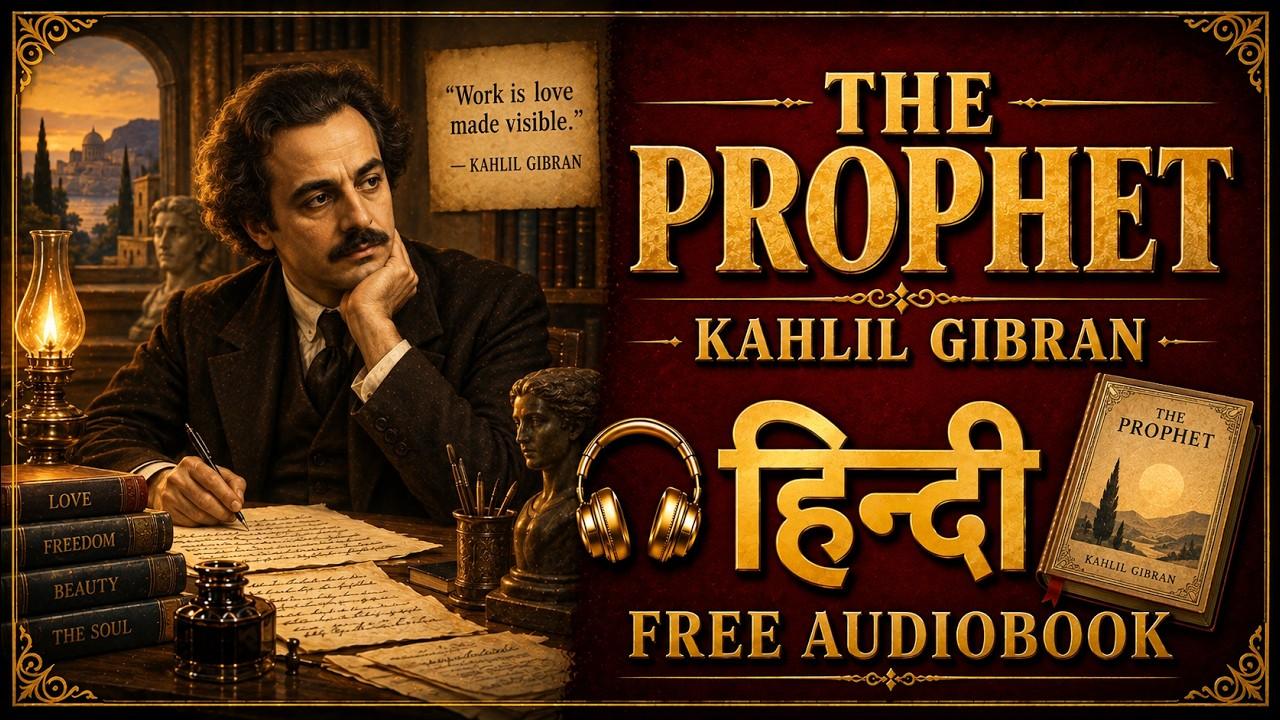
Listen to The Prophet by Kahlil Gibran (खलील जिब्रान की द प्रोफेट) in this complete, free Hindi audiobook exploring love, marriage, children, work, freedom, friendship, happiness, sorrow, and the deeper meaning of life.
What does it mean to truly love someone?
How can we find happiness without becoming afraid of sadness?
Should we try to control the people we care about?
And how can we live with greater wisdom, kindness, and inner peace?
These are some of the questions explored in The Prophet, one of the most widely read works of spiritual and philosophical literature.
Written by Kahlil Gibran and first published in 1923, the book presents 26 poetic teachings about everyday human experiences.
Rather than offering a complicated philosophical system, Gibran explores familiar subjects through simple images, reflections, and conversations.
The story follows a wise man named Almustafa, who has lived in the city of Orphalese for twelve years.
When a ship finally arrives to take him back to his homeland, the people of the city gather to hear his final words.
They ask him about the things that matter most in life.
Love.
Marriage.
Children.
Giving.
Work.
Joy and sorrow.
Freedom.
Friendship.
Religion.
Death.
Through his answers, Gibran offers a beautiful meditation on what it means to be human.
Our complete Hindi audiobook includes all 26 teachings, along with the opening and farewell, making this classic work accessible to Hindi-speaking listeners.
You can listen for free on YouTube or Spotify.
Listen to The Prophet on YouTube
Experience the complete Hindi audiobook of The Prophet by Kahlil Gibran on our YouTube channel.
This recording follows Almustafa's final conversations with the people of Orphalese, exploring timeless questions about relationships, personal freedom, happiness, suffering, and spiritual understanding.
The Prophet – Complete Hindi Audiobook
Listening time: Approximately 1 hour and 40 minutes
The audiobook includes the opening story, all 26 philosophical teachings, and the farewell.
In this recording, you will discover:
- What Gibran teaches about true love
- Why marriage requires both closeness and personal freedom
- How parents can guide children without controlling their lives
- The deeper meaning of generosity
- Why work can be an expression of love
- How joy and sorrow are connected
- What it means to be truly free
- Why reason and passion both matter
- How pain can lead to greater understanding
- The value of genuine friendship
- How to understand good and evil
- The relationship between spirituality and everyday life
- What death teaches us about living
Listen to the complete audiobook:
The Prophet by Kahlil Gibran – Full Hindi Audiobook on YouTube
The Prophet – Complete Listening Guide
The original book contains an opening section, 26 teachings, and a farewell.
The teachings appear in this order:
- On Love
- On Marriage
- On Children
- On Giving
- On Eating and Drinking
- On Work
- On Joy and Sorrow
- On Houses
- On Clothes
- On Buying and Selling
- On Crime and Punishment
- On Laws
- On Freedom
- On Reason and Passion
- On Pain
- On Self-Knowledge
- On Teaching
- On Friendship
- On Talking
- On Time
- On Good and Evil
- On Prayer
- On Pleasure
- On Beauty
- On Religion
- On Death
The book ends with The Farewell, which begins at approximately 01:22:36 in our recording.
Each teaching is relatively short, so you can listen to the complete audiobook or return to individual subjects for reflection.
Explore Our Free Hindi Audiobook Collection
Our YouTube channel offers a growing collection of free audiobooks on philosophy, spirituality, literature, personal development, and timeless wisdom.
Browse All Free Hindi Audiobooks on YouTube
Listen to The Prophet on Spotify
Prefer listening on Spotify?
You can also enjoy The Prophet by Kahlil Gibran as a complete Hindi audiobook on Spotify.
Listen to Almustafa's teachings on love, marriage, children, friendship, work, freedom, and inner peace.
The book is especially suitable for quiet reflection, daily listening, or exploring important questions about life and relationships.
The Prophet – Full Hindi Audiobook on Spotify
Listen to this philosophical and spiritual classic in Hindi, including all 26 teachings and the final farewell.
Full audiobook:
The Prophet by Kahlil Gibran – Complete Hindi Audiobook on Spotify
About The Prophet by Kahlil Gibran
The Prophet is a book of poetic essays written by Lebanese-American author, poet, and artist Kahlil Gibran.
It was first published in English in 1923.
The book is written in a poetic, reflective style and presented through the words of a fictional wise man named Almustafa.
After spending twelve years in the city of Orphalese, Almustafa sees a ship arriving to take him back to the island of his birth.
As he prepares to leave, the people gather around him.
They have grown to respect him and do not want him to depart without sharing his wisdom.
A seeress named Almitra asks him to speak about love.
Other members of the community then ask questions about different parts of human life.
Almustafa responds with a series of teachings.
His answers are not conventional instructions about how to become wealthy, successful, or powerful.
Instead, they encourage readers to examine their relationships, emotions, responsibilities, and understanding of themselves.
Gibran uses nature, everyday experiences, and poetic comparisons to explore complex ideas in memorable ways.
He compares relationships to living things that need room to grow.
He presents work as something that can carry love and meaning.
He explains sorrow as an experience connected to our capacity for joy.
He suggests that spiritual life should not be separated from ordinary actions.
The book draws on a broad spiritual outlook rather than presenting the teachings of one religious tradition alone.
Its ideas have appealed to readers from many cultures and backgrounds.
More than a century after publication, The Prophet remains a widely read book about human relationships and the search for meaning.
Who Was Kahlil Gibran?
Kahlil Gibran (1883–1931) was a Lebanese-American writer, poet, philosopher, and visual artist.
He was born in Bsharri, in present-day Lebanon, which was then part of the Ottoman Empire.
His family later immigrated to the United States.
Gibran spent important periods of his life in both the Middle East and the United States, and he also studied art in Paris.
These different cultural experiences helped shape his writing.
His works often explore love, spirituality, freedom, suffering, human relationships, and the connection between the individual and the wider world.
Gibran wrote in Arabic and English.
Among his best-known books are:
- The Prophet
- The Madman
- The Forerunner
- Sand and Foam
- Jesus, the Son of Man
- The Garden of the Prophet
The Prophet became his most famous work.
Its popularity comes partly from the way it combines philosophical questions with an emotional and poetic style.
Instead of presenting ideas through formal arguments, Gibran invites readers to think and feel.
His writing can be interpreted differently depending on a reader's beliefs, personal experiences, and stage of life.
What Is the Main Message of The Prophet?
A meaningful life comes from learning to love, accept change, understand ourselves, and live with compassion and awareness.
There is no single lesson that summarizes all 26 teachings.
Each section addresses a different part of human experience.
However, several ideas appear throughout the book.
Gibran repeatedly suggests that human beings grow through both happiness and difficulty.
Love brings joy, but it can also make us vulnerable.
Relationships create connection, but they should not remove individuality.
Work can feel like a burden, but it can also become meaningful when performed with care.
Freedom is important, but true freedom requires understanding our fears and attachments.
Pain is uncomfortable, but it can sometimes change the way we see ourselves and the world.
These ideas are connected by a broader message.
We cannot fully experience life by accepting only the parts that feel comfortable.
Love, sorrow, growth, responsibility, freedom, and loss are all part of being human.
Gibran encourages readers to understand these experiences rather than constantly trying to escape them.
Complete Guide to the 26 Teachings of The Prophet
The following guide explains each teaching in simple language.
It follows the original order of Gibran's book and highlights the main philosophical ideas.
The Coming of the Ship – Almustafa Prepares to Leave
The story opens as Almustafa sees the ship that will take him back to his homeland.
He has spent twelve years in Orphalese.
Although he longs to return, he also feels sadness about leaving the people and places that have become part of his life.
The people gather near the harbor and ask him to share his wisdom.
Almitra, a seeress who recognized his significance when he first arrived, invites him to speak.
Their conversation becomes the foundation for the 26 teachings that follow.
The opening establishes a central theme of the book.
Life involves both arrival and departure.
We form connections, learn from experiences, and eventually move on.
1. On Love – Love Cannot Be Controlled
The first teaching explores the nature of love.
Almitra asks Almustafa to speak about it.
He explains that love can bring great happiness, but it may also challenge and transform us.
Love is not simply a comfortable feeling.
It can expose fears, weaknesses, and emotional attachments.
Gibran suggests that genuine love requires openness rather than an attempt to control every outcome.
We cannot demand that love always remain easy.
We also cannot force another person to feel exactly what we want.
Main lesson: Love involves both joy and vulnerability. It becomes more meaningful when we accept its uncertainty.
2. On Marriage – Stay Close Without Losing Yourself
In this section, Almustafa discusses marriage and partnership.
He celebrates the connection between two people while emphasizing that each person should retain an independent identity.
A strong marriage does not require partners to become identical.
Two people can love each other deeply while maintaining their own interests, thoughts, and personal growth.
Gibran uses poetic images to suggest that healthy relationships need space.
A partnership should support individuality rather than erase it.
This lesson remains relevant to modern relationships.
Main lesson: The healthiest relationships combine closeness with personal freedom.
3. On Children – Love Them Without Owning Them
One of the book's best-known teachings concerns parenthood.
Almustafa explains that children have their own lives and futures.
Parents can care for them, guide them, and provide support.
But they cannot fully control who their children become.
Every generation enters a world different from the one its parents knew.
Trying to force children to reproduce their parents' beliefs and ambitions may prevent them from developing their own identity.
Gibran encourages parents to recognize the independence of the next generation.
Main lesson: Children need love and guidance, but they also need the freedom to become themselves.
4. On Giving – True Generosity Comes From the Heart
Almustafa explores the difference between giving possessions and giving something of ourselves.
Generosity is not measured only by the amount of money someone donates.
A person with little may give something meaningful.
Another person may donate large amounts while feeling little genuine concern for others.
Gibran encourages readers to recognize the human connection behind giving.
He also questions the habit of constantly judging who deserves help.
The teaching invites us to consider generosity as an expression of compassion rather than a transaction.
Main lesson: Giving becomes meaningful when it comes from sincere care rather than a desire for recognition.
5. On Eating and Drinking – Respect the Life That Sustains You
This teaching addresses humanity's relationship with food and the natural world.
Almustafa encourages gratitude for the plants, animals, and natural processes that sustain human life.
Eating is presented as more than satisfying hunger.
It connects us to the world around us.
The teaching invites reflection on how living beings depend on one another.
For modern readers, it can encourage greater awareness of food, consumption, and the responsibilities involved in sustaining life.
Main lesson: Appreciate the natural world and the lives that make your own existence possible.
6. On Work – Work Can Become an Expression of Love
Almustafa discusses the meaning of work.
He suggests that work is not only something people do to survive.
It can also connect people to the world and to one another.
When a person approaches a task with care, attention, and responsibility, ordinary labor can become meaningful.
This does not mean every job is enjoyable or that difficult working conditions should be ignored.
Rather, Gibran encourages readers to recognize the human value of creating, building, and contributing.
His reflections also connect naturally with the idea of acting with dedication without becoming completely controlled by the outcome, a theme readers can explore in our Bhagavad Gita full Hindi audiobook.
Main lesson: Work can become more fulfilling when approached with care, purpose, and responsibility.
7. On Joy and Sorrow – Happiness and Sadness Are Connected
This is one of the most emotionally powerful sections.
Almustafa explains that joy and sorrow are not entirely separate experiences.
Our capacity for happiness is often connected to our ability to feel sadness.
The things that bring the greatest joy can also create the possibility of deep loss.
For example, loving someone brings happiness, but it also makes us vulnerable to separation.
Gibran does not suggest that suffering is always beneficial.
Instead, he reminds readers that difficult emotions are part of a complete human life.
Main lesson: Accepting sadness does not mean rejecting happiness. Both belong to the human experience.
8. On Houses – A Home Should Support Life
Almustafa speaks about houses and the meaning of home.
A house provides shelter, security, and comfort.
But he warns against allowing possessions and physical structures to become the center of existence.
People need protection from the outside world.
Yet they also need freedom, imagination, and a connection with nature.
The teaching asks whether our homes support our lives or whether we sometimes shape our lives around maintaining what we own.
Main lesson: A good home provides security without becoming a prison.
9. On Clothes – Look Beyond Appearances
In this section, Gibran uses clothing to explore the relationship between outward appearance and inner freedom.
Clothes protect us and help us participate in society.
But they can also become symbols of status, modesty, pride, or insecurity.
The teaching encourages readers not to confuse appearance with genuine character.
A person's value cannot be determined simply by expensive clothing or social presentation.
Main lesson: What we wear can express something about us, but it does not define who we are.
10. On Buying and Selling – Trade With Fairness
Almustafa discusses commerce, exchange, and the responsibilities people have toward one another.
He recognizes that people depend on the work and resources of others.
Farmers, craftspeople, merchants, and workers contribute to the community in different ways.
The teaching emphasizes fairness rather than greed.
Economic exchange should not be separated from human dignity.
For Gibran, the things people buy and sell are connected to labor, nature, and mutual dependence.
Main lesson: Honest exchange should respect both the people involved and the value of their contributions.
11. On Crime and Punishment – Understand the Causes of Wrongdoing
This section examines justice, wrongdoing, and responsibility.
Almustafa questions the idea that people who commit crimes are completely separate from the societies in which they live.
Individual responsibility matters.
But human behavior is also influenced by relationships, circumstances, and shared institutions.
Gibran encourages a deeper understanding of wrongdoing instead of relying only on blame.
The teaching asks us to consider what justice should achieve.
Is its purpose simply to punish?
Or should it also help people understand the harm that has occurred?
Main lesson: Justice requires responsibility, but it can also benefit from compassion and understanding.
12. On Laws – Rules Should Not Replace Understanding
Almustafa discusses the rules people create to organize society.
Laws can help communities function.
But people sometimes become so attached to their own rules that they forget the purposes those rules were meant to serve.
Gibran encourages readers to think about the difference between following a rule and understanding what is right.
Not every familiar custom is necessarily wise.
And not every social expectation reflects a deeper moral truth.
Main lesson: Rules are useful, but they should be examined through fairness, wisdom, and human understanding.
13. On Freedom – Inner Freedom Matters Most
This teaching explores the complicated meaning of freedom.
People often imagine freedom as the absence of outside restrictions.
But Almustafa suggests that human beings can remain trapped by their own fears, habits, and attachments.
A person may have many choices yet still feel controlled by anger, anxiety, or the need for approval.
The teaching invites us to examine the restrictions we create within ourselves.
This idea has interesting similarities with Stoic philosophy, particularly Epictetus's distinction between what we can and cannot control.
Our The Enchiridion Hindi audiobook by Epictetus explores that distinction in greater detail.
Main lesson: Real freedom involves understanding and managing our inner attachments, not simply removing external limits.
14. On Reason and Passion – Balance the Mind and Heart
Almustafa speaks about the relationship between rational thinking and emotional desire.
Reason helps us understand consequences and make thoughtful decisions.
Passion provides energy, motivation, and emotional intensity.
When one completely dominates the other, life can become unbalanced.
A person guided only by impulse may act without considering the consequences.
A person who rejects emotion entirely may lose enthusiasm and connection.
Gibran encourages harmony between these forces.
Main lesson: A meaningful life needs both clear thinking and emotional vitality.
15. On Pain – Difficulty Can Change Our Understanding
This teaching explores suffering and personal growth.
Almustafa presents pain as an experience that can challenge familiar beliefs and reveal aspects of ourselves we previously did not understand.
Difficult experiences can force us to confront realities we would rather avoid.
However, this does not mean every form of suffering is necessary or desirable.
Gibran's reflections are poetic rather than a claim that all pain leads to improvement.
His discussion shares a concern with suffering and the mind found in Buddhist philosophy.
Listeners interested in that subject can explore our Dhammapada full Hindi audiobook, which examines craving, awareness, compassion, and inner peace.
Main lesson: Pain can become an opportunity for reflection, even though suffering itself should not be romanticized.
16. On Self-Knowledge – Understand Yourself Honestly
Almustafa discusses the difficulty of knowing ourselves.
Human beings are complicated.
Our thoughts, motivations, fears, and desires are not always easy to understand.
Sometimes we discover something important about ourselves only through difficult experiences.
Gibran encourages self-examination without assuming that we can completely define or measure the human spirit.
Knowing ourselves is an ongoing process rather than a single achievement.
This connects with questions about individuality and independent judgment explored in our Self-Reliance full Hindi audiobook by Ralph Waldo Emerson.
Main lesson: Self-knowledge develops through honesty, reflection, and continued experience.
17. On Teaching – A Teacher Helps Others Discover
This teaching explores the relationship between learning and guidance.
Almustafa suggests that a teacher cannot simply transfer personal wisdom into another person's mind.
Good teaching creates opportunities for understanding.
A teacher can explain, encourage, and ask important questions.
But students must also develop their own insights.
This applies to education, parenting, mentorship, and personal development.
Main lesson: Great teaching supports independent understanding rather than demanding blind imitation.
18. On Friendship – Friendship Is More Than Companionship
Almustafa describes friendship as an important source of emotional connection and personal growth.
A true friend is not simply someone who helps us escape boredom.
Friendship involves honesty, care, and mutual understanding.
People should be able to share both happiness and difficulty.
Gibran also suggests that friendship should not depend entirely on constant physical presence.
Meaningful connections can remain important even when people are separated by time or distance.
Main lesson: Genuine friendship grows through sincerity, generosity, and respect.
19. On Talking – Words Should Have Meaning
This teaching examines speech and silence.
People often talk because they feel uncomfortable with quietness.
They may speak to avoid difficult thoughts or to fill empty moments.
Almustafa encourages readers to recognize the value of both words and silence.
Not every thought needs to be spoken immediately.
And not every conversation leads to genuine understanding.
Good communication requires attention to what we say and why we say it.
Main lesson: Speak with purpose, and learn to appreciate silence.
20. On Time – Live Beyond Constant Measurement
Almustafa reflects on humanity's experience of time.
People divide life into hours, days, months, and years.
These measurements are useful.
But our emotional experience of life is not always captured by a clock.
A brief moment can remain meaningful for many years.
A long period may pass without leaving a strong memory.
Gibran invites readers to think about time as part of a larger experience rather than simply a sequence of measurements.
Main lesson: Do not become so focused on measuring time that you forget to experience life.
21. On Good and Evil – Human Nature Is Complicated
This section explores the relationship between goodness and wrongdoing.
Almustafa encourages readers to avoid treating every person as entirely good or entirely evil.
Human behavior is often shaped by unmet needs, confusion, weakness, and imperfect understanding.
People can act generously in one situation and selfishly in another.
Gibran suggests that understanding human imperfection requires humility.
This does not mean harmful behavior should be excused.
Rather, the teaching invites us to examine people with greater depth.
Main lesson: Human character is complicated, and understanding others requires more than simple labels.
22. On Prayer – Spirituality Is More Than Asking for Help
Almustafa discusses prayer as an expression of the human spirit.
People often pray when they are afraid, suffering, or hoping for something.
But he suggests that spiritual reflection can also arise from gratitude, joy, and a sense of connection with life.
Prayer is presented as more than a request for personal benefits.
It can become an expression of awareness and humility.
Gibran's broad reflections on spiritual life can be explored alongside other philosophical approaches to faith and personal belief, including our Religio Medici Hindi audiobook by Sir Thomas Browne.
Main lesson: Spiritual reflection can come from gratitude and joy as well as difficulty.
23. On Pleasure – Enjoy Life Without Losing Balance
This teaching examines pleasure and its place in human life.
Pleasure can be a natural and valuable part of existence.
But it should not become the only thing that guides our decisions.
Almustafa invites readers to consider the relationship between enjoyment, responsibility, and personal understanding.
The goal is not to reject every pleasure.
It is to appreciate life's experiences without allowing them to control us completely.
Main lesson: Enjoyment has value, but a good life involves more than the pursuit of immediate satisfaction.
24. On Beauty – Beauty Is More Than Appearance
Almustafa explores the meaning of beauty.
People often search for beauty in faces, objects, buildings, or landscapes.
But Gibran suggests that beauty is also connected to perception, emotion, and our relationship with life.
Something may appear ordinary to one person and deeply meaningful to another.
Beauty cannot always be reduced to a single definition.
The teaching encourages openness to the world rather than judging everything through fixed expectations.
Main lesson: Beauty involves how we experience and understand life, not only what we see.
25. On Religion – Spiritual Life Is Everyday Life
In this teaching, Almustafa challenges the habit of separating spirituality from ordinary living.
People may think of religion as something practiced only in a temple, church, mosque, or other sacred place.
But Gibran encourages readers to consider how their daily actions reflect their deeper beliefs.
Work, relationships, kindness, responsibility, and compassion can all become part of a spiritual life.
The teaching is not limited to one religious doctrine.
Instead, it offers a broad reflection on the relationship between belief and behavior.
The emphasis on living in harmony with a larger reality also creates an interesting comparison with our Tao Te Ching Hindi audiobook by Laozi.
Main lesson: Spiritual values become meaningful when they shape everyday actions.
26. On Death – Understanding Life Means Accepting Its End
The final teaching addresses death.
Almustafa encourages the people to recognize that life and death are connected.
Human beings often fear death because it represents uncertainty and separation.
But Gibran presents death as part of the larger natural process of existence.
His poetic reflections do not provide a scientific explanation of death.
Instead, they invite readers to consider mortality with greater acceptance and less fear.
The teaching also encourages appreciation of life.
Recognizing that our time is limited can change how we value relationships, experiences, and everyday moments.
Main lesson: Accepting mortality can deepen our appreciation of being alive.
The Farewell – Almustafa Leaves Orphalese
Begins at approximately 01:22:36
After answering the people's questions, Almustafa prepares to leave.
The ship is waiting.
The people have heard his teachings, but they are saddened by his departure.
His final reflections return to the themes of connection, understanding, and the continuing movement of life.
The farewell is important because the book does not end with a simple list of instructions.
It ends with a separation.
The teacher must leave, and the people must continue living.
They cannot depend on his physical presence forever.
Instead, they must find meaning in what they have learned and in their own experiences.
The ending suggests that wisdom is not something we receive once and then possess permanently.
It is something we continue discovering throughout life.
Main Characters in The Prophet
Unlike a traditional novel, The Prophet does not contain a complicated plot with many character developments.
Its central focus is the teachings of Almustafa.
However, several figures help establish the story's setting.
Almustafa
Almustafa is the central figure and the speaker who delivers the 26 teachings.
He has lived in Orphalese for twelve years.
When the ship arrives to take him home, the people gather to hear his final words.
He represents the search for wisdom, understanding, and spiritual insight.
His teachings explore the different parts of human experience.
Almitra
Almitra is a seeress in Orphalese.
She recognized Almustafa when he first arrived in the city.
When he prepares to leave, she asks him to speak to the people about life.
Her question about love begins the series of teachings.
Almitra plays an important role in connecting Almustafa's private reflections with the needs of the community.
The People of Orphalese
The people represent different human concerns and responsibilities.
Among those who speak are individuals associated with marriage, parenting, work, trade, justice, teaching, and religion.
Their questions allow Gibran to explore experiences shared by people across different cultures and generations.
Important Life Lessons from The Prophet
1. Love Needs Freedom
Trying to control another person can damage a relationship.
Gibran encourages connection that allows both people to grow.
2. Happiness and Sadness Are Both Parts of Life
A meaningful life does not consist entirely of pleasant experiences.
Difficult emotions can exist alongside joy, love, and gratitude.
3. Your Children Have Their Own Futures
Parents can guide and support children without trying to control every part of their identities.
4. Generosity Is About More Than Money
Giving time, attention, kindness, and genuine care can be just as meaningful as giving possessions.
5. Find Meaning in Your Work
Work becomes more fulfilling when connected to purpose, care, and contribution.
6. True Freedom Begins Within
People may be restricted by their fears and attachments even when they have many external choices.
7. Balance Reason With Emotion
Thoughtful decisions require both rational understanding and awareness of our feelings.
8. Learn From Difficult Experiences
Pain does not automatically create wisdom, but reflection can sometimes help us grow through difficult circumstances.
9. Value Honest Friendship
Friendship should involve genuine care rather than only convenience or entertainment.
10. Do Not Confuse Appearance With Character
A person's possessions, clothing, or social position do not reveal their full moral worth.
11. Keep Learning About Yourself
Self-understanding is not something we complete once.
It develops throughout life.
12. Let Your Values Shape Your Actions
Spiritual beliefs and ethical principles become more meaningful when reflected in daily behavior.
13. Appreciate Ordinary Moments
Life is not valuable only during extraordinary achievements.
Everyday relationships and experiences also matter.
14. Accept Change
Relationships, circumstances, and personal identities develop over time.
Trying to prevent all change can create unnecessary suffering.
15. Remember That Life Is Limited
Recognizing mortality can encourage greater gratitude, compassion, and attention to what matters.
Love and Marriage in The Prophet
Two of the most famous sections of The Prophet concern love and marriage.
These teachings remain relevant because romantic relationships often create tension between closeness and independence.
People want to feel connected to their partners.
They want emotional safety, affection, and shared experiences.
But they also need room to develop as individuals.
Gibran challenges the assumption that love requires complete possession.
He suggests that a relationship should not eliminate personal freedom.
Two people may share a home and build a future together.
But each person still has an independent inner life.
This can be understood as a reminder that strong relationships need both commitment and respect.
Trust becomes especially important.
Trying to control another person's friendships, opinions, or personal growth may create resentment.
In contrast, allowing space for individuality can help relationships remain healthy.
Gibran also recognizes that love can bring suffering.
Being emotionally close to someone means becoming vulnerable.
The possibility of disappointment or loss cannot be removed completely.
His message is not to avoid love because it carries risks.
It is to understand that genuine connection requires courage.
What Does The Prophet Teach About Happiness?
Gibran does not describe happiness as a permanent state in which nothing unpleasant ever happens.
Instead, he explores the relationship between joy and sorrow.
The people and experiences that create our greatest happiness can also make us vulnerable to sadness.
Someone may experience extraordinary joy through friendship or family.
But those relationships also create the possibility of separation.
A meaningful achievement can bring pride and satisfaction.
Yet the effort required to achieve it may involve uncertainty and disappointment.
Gibran encourages readers to see these emotional experiences as connected.
The goal is not to search for suffering.
Nor is it to deny the importance of happiness.
It is to recognize that life includes a wide range of feelings.
This perspective can help readers approach difficult periods with greater understanding.
A painful moment does not necessarily erase the happiness that came before it.
And an experience that ends may still have been meaningful.
Is The Prophet a Religious or Philosophical Book?
The Prophet can be described as both philosophical and spiritual literature.
It contains reflections on love, morality, freedom, suffering, and human relationships.
It also addresses prayer, religion, and death.
However, it does not function as a conventional religious instruction book.
It does not present a single organized set of doctrines that readers must accept.
Instead, Gibran uses poetic language and spiritual imagery to explore questions shared across different traditions.
His writing reflects a broad interest in spirituality and the human experience.
Readers from different religious backgrounds may interpret its teachings in different ways.
Others may approach it primarily as literature or philosophy.
Its central themes can be meaningful even for listeners who do not follow a particular religious tradition.
Why The Prophet Still Matters Today
More than one hundred years after its publication, The Prophet continues to speak to problems that remain part of everyday life.
People still struggle with love and relationships.
Parents still worry about how to guide their children.
Many people search for meaning in their work.
Others want greater freedom, inner peace, or a better understanding of themselves.
Modern life offers extraordinary opportunities for communication, travel, education, and personal choice.
But it also creates new forms of pressure.
People compare their lives with others.
They worry about money, appearance, relationships, and social approval.
They may become so focused on future achievements that they overlook the meaning of their present experiences.
Gibran's teachings invite readers to examine these patterns.
His discussion of love challenges the idea that affection means control.
His reflections on marriage remind people that relationships need both commitment and individuality.
His teaching about children encourages parents to recognize the independence of future generations.
His discussion of work asks whether people can find meaning in what they contribute.
His thoughts about freedom encourage readers to examine fears and attachments that may limit their choices.
These ideas are not always easy to apply.
And some readers may disagree with Gibran's conclusions.
But the value of the book lies partly in the questions it raises.
How do we love without trying to possess another person?
How can we work with purpose?
How do we remain compassionate when others make mistakes?
What does it mean to be free?
Can we accept sadness without allowing it to define our lives?
How should we respond to the knowledge that life will eventually end?
These questions have no simple answers.
Yet thinking about them can help people develop greater awareness of their choices.
The book also encourages a sense of connection with the natural world.
Food, work, homes, relationships, and even ordinary daily activities are presented as parts of a larger human experience.
This makes The Prophet different from books that focus exclusively on achieving success.
It is less concerned with helping readers become rich, famous, or powerful.
Its greater interest is in helping them understand how to live with more love, wisdom, and compassion.
The lasting message of The Prophet is that a meaningful life is not found by escaping every difficulty, but by learning to live more fully and honestly through all of life's experiences.
Frequently Asked Questions About The Prophet by Kahlil Gibran
Is The Prophet available as a free Hindi audiobook?
Yes. Our complete Hindi audiobook is available for free on YouTube.
You can also access the Spotify audiobook through the link earlier in this article.
Who wrote The Prophet?
The book was written by Kahlil Gibran, a Lebanese-American poet, writer, and artist.
When was The Prophet published?
It was first published in English in 1923.
How many chapters are in The Prophet?
The book contains 26 themed teachings, along with the opening story and final farewell.
How long is The Prophet Hindi audiobook?
Our recording runs for approximately 1 hour and 40 minutes.
Who is Almustafa?
Almustafa is the central character who shares the book's philosophical teachings.
He has lived in Orphalese for twelve years and speaks to the people before leaving.
Who is Almitra?
Almitra is a seeress who asks Almustafa to share his wisdom with the people of Orphalese.
She begins the teachings by asking about love.
What is The Prophet about?
The book explores human experiences such as love, marriage, parenting, giving, work, happiness, sorrow, freedom, friendship, spirituality, and death.
What is the main message of The Prophet?
One central message is that a meaningful life requires love, self-understanding, compassion, and acceptance of the full range of human experiences.
Is The Prophet a story or a philosophy book?
It is a work of philosophical prose poetry presented through a fictional narrative.
The story provides a setting for 26 teachings on different subjects.
What does The Prophet say about love?
Gibran presents love as a powerful experience that brings both happiness and vulnerability.
He encourages openness rather than attempts to possess or control love.
What does The Prophet say about marriage?
The marriage teaching emphasizes connection while preserving individuality.
Partners should love and support one another without losing their independent identities.
What does The Prophet say about children?
Children have their own lives and futures.
Parents can provide love and guidance, but should recognize their children's individuality.
What does The Prophet say about work?
Work can become meaningful when performed with care, purpose, and a sense of contribution.
What does The Prophet say about pain?
Pain can sometimes create opportunities for reflection and greater understanding.
The teaching presents suffering as part of human life rather than something that can always be avoided.
What does The Prophet say about freedom?
Freedom involves more than the absence of external restrictions.
It also requires understanding the fears and attachments that influence our choices.
What does The Prophet say about friendship?
Gibran presents friendship as a meaningful relationship built through sincerity, care, and mutual understanding.
What does The Prophet say about death?
The final teaching explores mortality as part of the larger process of life.
It encourages reflection on death without separating it completely from the meaning of existence.
Is The Prophet a religious book?
It is a spiritual and philosophical work influenced by broad religious and cultural traditions.
It is not a conventional religious rulebook or a text dedicated to one doctrine.
Is The Prophet suitable for beginners?
Yes. Its short teachings and familiar subjects make it approachable for people who are new to philosophy or spiritual literature.
Is The Prophet in the public domain?
The original 1923 English text is in the public domain in the United States.
Copyright rules differ by country, and modern translations and audiobook recordings may have their own protection.
Where can I listen to The Prophet in Hindi?
You can listen to the complete audiobook on YouTube or Spotify using the links near the beginning of this article.
Final Thoughts – Living With Love and Wisdom
The Prophet does not promise that life will always be easy.
It does not offer a secret formula for avoiding sadness, disappointment, or uncertainty.
Instead, Kahlil Gibran invites us to examine how we experience the world.
He asks us to love without attempting to control.
To work with care.
To give with compassion.
To respect the independence of others.
To seek understanding rather than simply approval.
To recognize the value of joy without denying sorrow.
And to remember that life is meaningful even though it is constantly changing.
These reflections are what make The Prophet worth returning to.
A teaching that seems simple during one stage of life may become more meaningful during another.
Someone experiencing a new relationship may connect with the chapters on love and marriage.
A parent may find particular meaning in the teaching on children.
A person facing uncertainty may return to the sections on freedom, pain, or self-knowledge.
And someone reflecting on the passage of time may find comfort in the final teachings.
You do not need to agree with every idea to appreciate the book.
The purpose of philosophical reflection is not always to provide final answers.
Sometimes it is to help us ask better questions.
At Free Hindi Audiobooks, we are building a growing library of classic literature, philosophy, and spiritual works in Hindi so that more people can discover these ideas without financial barriers.
Listen to The Prophet in Hindi, reflect on its teachings, and return to the sections that speak most directly to your own life.